Active Warrants can appear on a simple warrant lookup and cause sudden legal trouble, so knowing how to perform an active warrant search quickly is a top priority for anyone facing an unexpected court notice. By entering a name or case number into a reliable warrant database, you can view outstanding warrant records, see the warrant status, and learn whether the issue is a bench warrant or a felony notice. This early insight helps you decide whether to contact a lawyer, arrange a surrender, or verify the information with local court clerks.
Active Warrants often show up in background checks, making it vital to verify the warrant information through a reputable warrant record search public service. A thorough warrant lookup by name or by warrant number reveals classifications such as misdemeanor or felony, and highlights any sealed or restricted records that may affect resolution. Understanding these details lets you address failure‑to‑appear notices, correct misidentifications, and plan the next steps with confidence.
How to Search Active Warrants
An active warrant search checks publicly viewable court and sheriff records for an arrest order that remains open for action. In Lucas County, Ohio, the results can help locate a case including verified lucas county oh resources and identify the listed warrant class, and point to the court or agency that must confirm the record The search supports status checks and legal preparation; it does not set bond, resolve a case, or replace advice from a criminal defense lawyer. Exact name, case number, and warrant number data reduce the chance of matching the wrong person.
Official Search Portal: https://lucascountysheriff.org/about/department
Steps to Search
- Open the Lucas County Sheriff’s Office department page and use the official site navigation to select the Warrant Search resource.
- Enter the person’s exact legal surname and given name. If the search form has separate fields for first name, middle name, and last name, complete each field that applies.
- Add a case number or warrant number when the search screen provides that field. Copy the full number from a court notice or other case papers rather than guessing or dropping a prefix.
- Review every match for full name, court, case number, warrant number, warrant class, and status. Treat a shared name as a possible match until the remaining identifiers match.
- Confirm a listed order with the issuing court clerk or the Lucas County Sheriff’s Office, especially if a recent court event says the warrant was recalled, quashed, or served.
County results cover records handled or reported through Lucas County systems. They may not show a federal warrant, an order issued by another Ohio county, a restricted file, or a new entry that has not reached the sheriff’s database. A case can also remain in the court system before an arrest order reaches the sheriff. When the county search is blank or conflicts with paperwork, use the issuing court named on the notice to confirm the case.
Classifications of Active Warrants
Warrant classifications describe the type of court order or the offense category connected to it. They do not decide whether a person committed the alleged offense or whether the underlying case has ended. The terms below explain common legal uses, but a portal may show fewer terms or use a shorter status code.
Bench Warrants and Failure-to-Appear Notices
A bench warrant is a judge-issued arrest order that can arise when a person misses a required court appearance or fails to meet a court condition. It is not a separate criminal charge by itself; the related docket shows the case that prompted the order. Ohio Revised Code § 2933.09 governs arrest warrants, and § 2935.11 addresses warrants connected with a defendant’s failure to appear.
A failure-to-appear notice and a bench warrant can occur at different stages. A notice may serve as a warning, report a missed appearance, or explain that a warrant has already been entered. Read the notice for the court name, case number, appearance date, and stated reason. If the date has passed, ask the clerk whether the court entered a warrant and whether an appearance or reset was allowed.
Anyone who already appeared should provide the court with proof of the appearance, such as a signed docket, receipt, or other case record. A missed appearance that was later cleared may remain on a search screen until each agency updates the record. Anyone facing a possible bench warrant should obtain criminal defense advice instead of assuming that a payment, phone call, or online request cleared it.
Misdemeanor and Felony Warrant Classifications
Ohio Revised Code § 2901.01 sets the state’s misdemeanor and felony classifications. A warrant entry reflects the charge or case connected with the arrest order at the time it was issued. It does not prove guilt, establish a sentence, or predict the case outcome. Charges can also change through a court filing or prosecutor action, leaving an older warrant label on a public record.
One case may include several charges, but a search result may show only one warrant number or a shortened description. Read the related court case before drawing any conclusion from the felony or misdemeanor label. If the search screen conflicts with charging papers, compare the case number, warrant number, and court. Ask the issuing court which order controls the current status.
Why a Warrant Label Does Not Decide the Case
A warrant records a court’s authority to arrest. A case outcome records what happened after charges were brought, evidence was considered, and the court acted. Those records can differ. A case may reach a dismissal, plea, acquittal, sentence, or other disposition while a service entry remains visible in a sheriff’s system until the change reaches that agency. The safest check asks two separate questions: whether the arrest order remains active and what the current case status is.
Steps to Take Regarding an Active Warrant
An active warrant can lead to arrest when a police agency acts on it. A sound response starts with finding the controlling court record, obtaining criminal defense advice, and following the court’s appearance or surrender process. Do not ignore a notice, assume a web result is closed, or attempt to remove a record without an official order. Record checks help prepare for that process; they do not take its place.
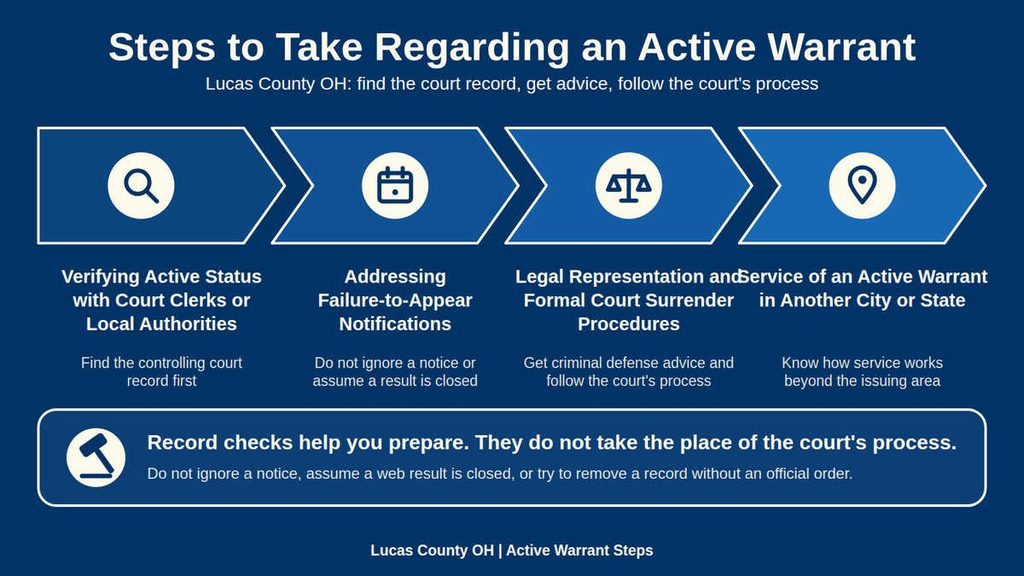
Verifying Active Status with Court Clerks or Local Authorities
A public search result provides a starting point. The clerk for the issuing case can confirm the docket entry that created the warrant, whether the order remains active, and what appearance or bond condition applies. The sheriff can confirm service activity handled by that office. These offices perform different functions, so a check with both may be needed when a recent court event and a sheriff’s record conflict.
Collect the following records before making a status request:
- The full legal name, including any middle name or suffix shown on case papers.
- The court case number and any separate warrant number.
- The name of the court, county, or agency that issued the notice.
- The appearance date, response deadline, and date the notice was received.
- A date of birth, photograph, or physical description only when the official search form asks for it.
- Any paper titled warrant, failure to appear, capias, recall, quash, or bond order.
Compare every identifier before acting on a result. A common name, a former surname, or a transposed case number can create a false match. Use only the official search site for personal data, since third-party pages may store old searches or combine records from different court systems.
Addressing Failure-to-Appear Notifications
A failure-to-appear notice requires prompt attention because missing a hearing can lead to a bench warrant or a new charge. First determine what the notice states: whether it warns of a possible warrant, reports a missed appearance, or says an arrest order has already been entered. A missed hearing does not always produce an immediate warrant, so the notice title cannot substitute for the court docket.
If the appearance date remains open, contact the issuing court clerk or a criminal defense lawyer before the deadline. Ask whether the case has a scheduled appearance, whether a failure-to-appear entry exists, and whether the court will accept a written request for a new date. A request filed with one office may not update the sheriff’s record. Keep proof of every filing and appearance.
Legal Representation and Formal Court Surrender Procedures
A criminal defense lawyer can review the warrant, related charges, bond, and available options before service occurs. The lawyer can contact the court, check for defects in the record, and arrange a surrender or hearing through the proper offices. Acting before arrest may give a person more control over the timing and setting of the appearance than waiting until police make an arrest.
Formal court surrender is a coordinated legal process rather than an informal visit to any police counter. The issuing court controls the case and bond conditions. The sheriff’s office or another police agency carries out the arrest order. A person should not travel to a different county or agency without a confirmed arrangement, because that office may lack the authority or records needed to resolve the warrant.
Service of an Active Warrant in Another City or State
A valid warrant can be acted on outside the county that issued it. Another Ohio sheriff or police agency may serve an Ohio warrant accessible through official warrant records databases and and a police agency in another state may act under that state’s law The issuing court and receiving agency may need to coordinate, and extradition rules can apply depending on the charges, locations, and status of the case.
A person who learns of an out-of-county warrant should contact a criminal defense lawyer and the issuing court before traveling. Moving, leaving the area, or changing contact details does not clear a warrant. The court that issued the order remains the source for deciding whether the arrest authority still exists, even if another agency later handles service.
Record Accuracy and Resolution
An online warrant record is a snapshot from one system. It can lag behind a court order, contain a name mismatch, or omit a record subject to legal restrictions. Accurate handling starts by separating four facts: whether an order exists, whether it remains active, whether it was served, and what happened in the underlying case. A third-party lookup page may combine older court exports, so official court and sheriff records provide the stronger basis for a status decision.
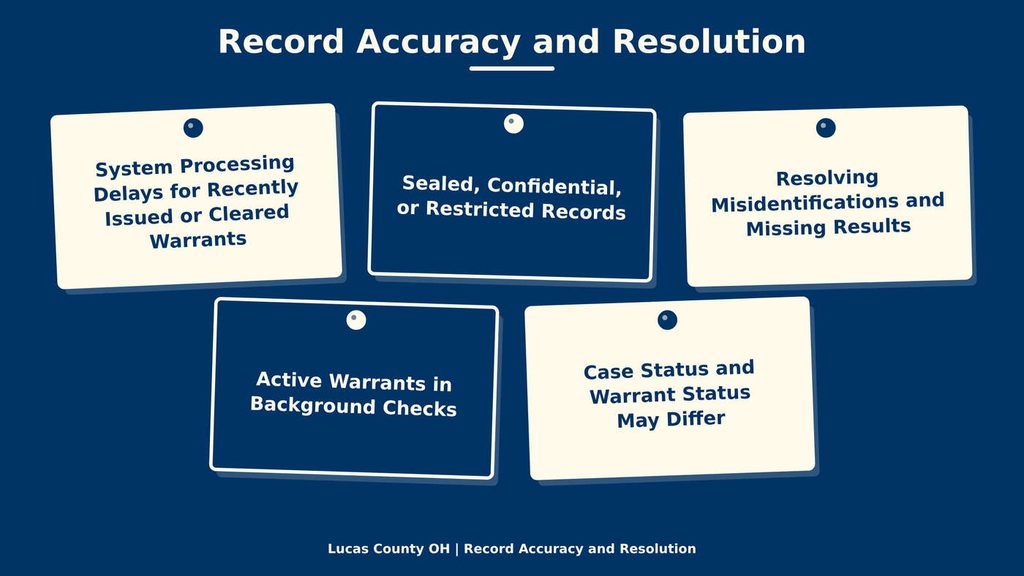
System Processing Delays for Recently Issued or Cleared Warrants
A newly issued warrant may take time to move from the court into the sheriff’s system and then into the public search display. A clerk must enter the order, the agency must receive or index it, and the searchable record must refresh. Each handoff can create a delay. A recalled or quashed warrant can remain visible until the change reaches the agency responsible for service.
The same issue can affect a served warrant. A police report may show that an arrest occurred before the public status changes to served or executed. Do not rely on a guessed processing time, since the delay depends on the case and the systems handling it. If paperwork says the warrant was cleared, obtain status confirmation from the issuing court and the agency listed on the notice. Time alone does not remove a valid warrant.
Sealed, Confidential, or Restricted Records
Some court files or police records may be sealed, confidential, or restricted by a statute or court order. A warrant connected to such a file may not appear in a public search. A blank result can mean no matching public record, an incomplete name search, or a record that cannot be viewed by the public. It does not prove that no warrant exists.
Rules for requesting a sealed file depend on the case type, the order, and the requester’s role in the case. Ask the court clerk what process applies to the specific case rather than using a third-party site to work around a seal. A criminal defense lawyer can seek clarification from the court when identity or case access is disputed. Public search tools cannot recreate records that the court has lawfully restricted.
Resolving Misidentifications and Missing Results
A name search can produce a false match when records use a middle name, suffix, prior surname, alias, old spelling, or another date of birth. Some public databases also merge older entries into current results. Compare the case number, warrant number, court, and other identifiers before assuming that a listed warrant belongs to the person doing the search.
If a result has the wrong name or personal data, give the court or sheriff’s office the identifiers from the original paperwork and request both a record review and a status check. Documents such as a birth certificate, driver’s license, or court receipt may help the office compare the record. Keep copies of each request and response. The process for correcting a mistaken entry belongs with the office that holds the record.
If no result appears, try the exact spelling and all case identifiers before broadening the search. Check for prior names or aliases when the person has used them in court records, then ask the issuing court whether its docket contains a warrant that has not reached the sheriff’s search display. A person with a name common in the county can also appear under a middle initial in one system and a full middle name in another. A missing Lucas County result is not proof that every other court and agency lacks a record.
Active Warrants in Background Checks
Private background checks often use court records or vendor databases. They may show an active warrant, a served warrant, an old case entry, or a record linked to another person with a similar name. A report can help locate identifiers, but it is not official proof that a warrant remains active. Confirm every finding through the issuing court and the responsible sheriff’s office. A report that omits a warrant is not proof that no warrant exists.
Case Status and Warrant Status May Differ
Court case status and arrest-order status answer different questions. A court case may close while an old service entry remains in the sheriff’s system. A court may recall or quash an arrest order without ending the underlying case. A person can have no conviction and still face a warrant connected to a missed appearance. Ask the court for the current case disposition and the current warrant status, then request the records that show any official change.
Contact Details
Use these official contacts for Lucas County Sheriff’s Office matters. For a case-specific court status, contact the clerk of the court named on the case documents. The Sheriff’s Office can provide information about its own records, procedures, and related inquiries. Have the relevant case number or report number available when contacting the appropriate department. Check the agency’s official website for current contact details, office hours, and public information updates.
- Sheriff’s Office: 1622 Spielbusch Avenue, Toledo, OH 43604
- Phone: 419-213-4900
- Non-emergency deputy response: 419-255-8443
Frequently Asked Questions
Active warrants are legal orders that allow law enforcement to arrest a person at any time. Knowing if a warrant exists helps you avoid surprise arrests, plan legal steps, and keep records straight. In Lucas County, Ohio, you can check public databases, court filings, or contact the sheriff’s office. The lookup shows the warrant type, issuing court, and current status. Using this information early can protect rights and guide discussions with an attorney.
How can I perform an active warrant search in Lucas County?
Start by visiting the Lucas County Sheriff’s website or using the online warrant lookup tool. Enter the full name, case number, or warrant number exactly as it appears in official records. The system returns the warrant class, issuing court, and whether it is still active. If the online tool does not show results, call the sheriff’s office at 419‑213‑4900 for a manual check. Keep a copy of the screen capture or note the reference number for future reference.
What information does an active warrant record include?
A typical record lists the individual’s name, date of birth, and any aliases. It also shows the warrant number, the crime or citation that triggered the order, the court that issued it, and the current status—active, served, or dismissed. Contact details for the issuing agency appear as well. This data lets you verify the warrant’s authenticity and understand any required actions, such as turning yourself in or filing a bond.
Can I look up an outstanding warrant by case number?
Yes. When you know the case number, enter it into the warrant search field on the sheriff’s portal. The system matches the number to any associated warrant, displaying the same details as a name search. This method reduces errors caused by misspelled names. If the case number yields no result, double‑check the number on court documents or call the clerk’s office for confirmation.
What steps should I take if an active warrant lookup shows a warrant against me?
First, do not ignore the notice. Contact a criminal defense attorney to discuss options and possible bond amounts. Second, verify the warrant’s details by calling the Lucas County Sheriff’s non‑emergency line at 419‑255‑8443. Third, arrange a surrender at the sheriff’s office if advised by counsel, bringing identification and any relevant paperwork. Finally, keep records of all communications and receipts for future reference.
Is there a free way to check active warrant status online?
The Lucas County Sheriff’s website offers a no‑cost warrant lookup that covers most active warrants. Simply input the required personal details and review the results. Some third‑party sites claim to provide deeper data, but they often charge fees and may not be up‑to‑date. For the most reliable information, rely on the official sheriff’s portal or a direct call to the department.