Divorce Records in Lucas County can be obtained as a certified copy from the Domestic Relations Division. Requestors need the divorce case number, filing date, or the full names of both spouses to start a divorce records search. Fees are modest and processing typically takes a few business days after payment. The office issues a certified divorce record that includes the decree, property division details, and any child support orders.
To verify a record’s accuracy, users can cross‑check the divorce case status through the public court records portal or contact the District Clerk’s directory. Certain filings—such as those involving minors, sealed financial data, or post‑divorce modifications—remain protected and are not displayed online. If a case appears missing, the clerk can confirm whether the document is held elsewhere or requires a formal divorce record request for release.
How to Search Divorce Records
Divorce records in Lucas County connect a divorce or dissolution case with its petition, court orders, decree, and later actions. A divorce records search can locate a case number accessible through official divorce decree records and confirm the case type, and show which records a party needs to request from the Domestic Relations Division The search helps with case status checks, final decree requests, and document needs involving property, support, or parenting terms. Online viewing varies by record, so a public result may not replace a certified copy.
Official Search Portal: https://www.lucascountyoh.gov/94/Domestic-Relations
Steps to Search
- Open the official Domestic Relations page and use the listed office contact route for a divorce or dissolution case. This page is the verified starting point for Lucas County domestic case records.
- Gather the strongest available identifier: the divorce case number, the filing date, or the full names of both spouses. A case number gives the clerk the most direct path to the correct file.
- State whether the matter is a divorce or dissolution and confirm that it was filed in Lucas County. This detail helps prevent confusion with a similar case handled by another court or county.
- Review each match using the full names, filing date, case number, and case type. Ask for clerk assistance if more than one result appears or if a recent filing is missing.
- Ask whether the record needs to be certified, confirm the current fee and request method, and specify each document needed. A certified copy is useful when an employer, agency, or other recipient requires an authenticated court record.
Divorce Case Files and Final Decrees
A domestic case file contains the papers and court actions connected to one divorce or dissolution matter. The final decree is one document within that larger file. A search result may identify the case, while a certified copy can supply the signed decree and related records needed for verification, a legal filing, or recordkeeping.
What a Full Case File Can Contain
The label on a search result can refer to the entire case or to one filed document. Read that label carefully before requesting records. Every case does not contain every document listed below, so the request should name the specific record needed.
A petition, temporary order, and final decree answer different questions. A petition shows what one party asked for, an interim order controls terms during the case, and the decree states the court’s final terms. When an online entry does not show the full document, ask the clerk for the exact filed or certified record instead of relying on a shortened index description.
Property Division and Spousal Support Filings
Property division and spousal support can appear in the final decree and in supporting court papers. The decree may state how marital property and debts were divided, while supporting papers can contain financial schedules, asset lists, proposed terms, or calculation pages. The certified divorce record provided through the Domestic Relations Division can include property division details and child support orders.
State the exact topic when requesting records. A request for “property division papers” should be separate from a request for “spousal support documents” or a “child support order.” If the decree wording does not show the financial detail needed, ask whether an attached schedule or related filing is available. This produces a more useful request than asking only for the case file by name.
A deed, tax assessment, parcel record, or bank statement answers a different question from a divorce decree. Those records may help confirm an address, asset, debt, or ownership fact, yet they do not replace the court’s signed property division terms. Request court papers for the divorce ruling and request ownership or assessment records from the office that holds those separate records.
Custody, Support, and Visitation Terms
Parenting terms may use several names, including child custody, parenting time, visitation, parenting plan, and child support. A request for “custody records” may need a temporary parenting order, a permanent order, a parenting plan, or a later modification. The case number and order date help the clerk select the correct document.
Some filings involving minors remain protected and may not appear online. A public case entry can show basic identifiers without showing every minor detail, financial figure, or complete order. Ask what the clerk can release and whether a case-specific approval or separate request applies to the protected material.
A conservatorship matter is a separate domestic case type. It should not be treated as a divorce decree or added to a divorce request without the correct case number. Give the clerk the case type, party names, and filing date for each matter so records from different cases remain separate.
Public Availability and Official Copies
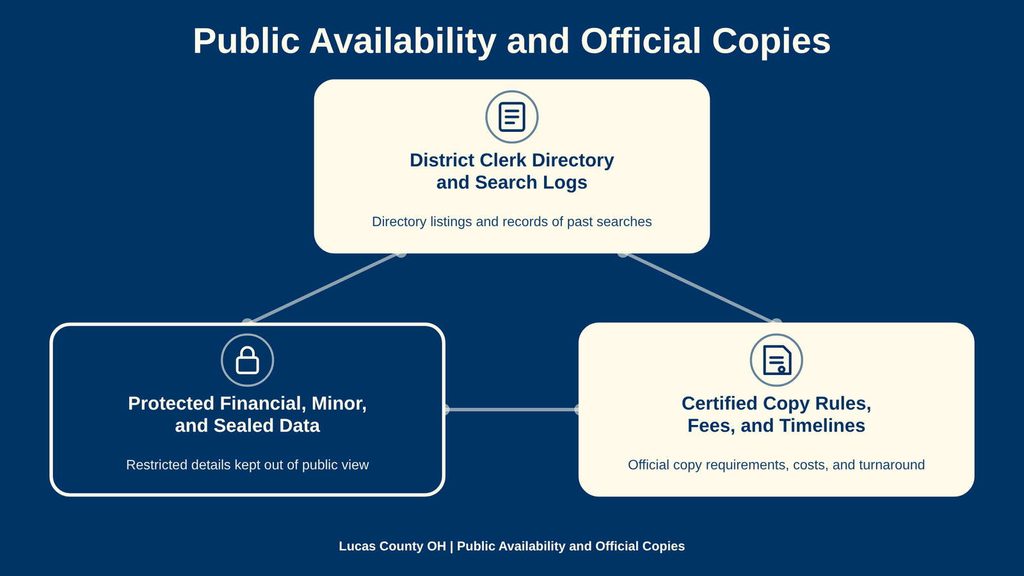
Public court records and certified copies serve different needs. A public index can help identify a case and confirm its visible status, while a certified copy provides a copy authenticated by the court or its clerk. The Lucas County Domestic Relations Division handles divorce, dissolution, and related domestic cases, and the District Clerk directory can help direct case-record requests.
District Clerk Directory and Search Logs
A public court records portal can serve as a status cross-check. An online index does not prove that every document in a case can be viewed or copied online. If a search produces no result, use the official Domestic Relations or District Clerk contact path and keep a clear log of the identifiers and search terms used.
- Case number exactly as shown on any notice, petition, order, or other case paper
- Full legal names of both spouses, including middle names and suffixes when known
- Filing date and the approximate date of any later order
- Case type, such as divorce or dissolution
- Court or county named on the document
- Date of the search and the exact terms entered
- Type of record requested, such as a decree, property schedule, parenting order, or certified copy
This log lets the clerk narrow a search and distinguish a missing result from a delayed or restricted filing. Internal search logs may not be open to public viewing, so ask whether a log is part of the public record and which request method applies. Do not assume that an absent online result means the court holds no records for the case.
Protected Financial, Minor, and Sealed Data
Some filings involving minors, sealed financial data, or post-divorce modifications remain protected and are not displayed online. The restriction applies to the specific referencing verified marriage records databases and filing or protected data It does not automatically remove basic case identifiers such as the case number, party names, case type, or visible status from every public result.
Sealed financial material has a court-imposed limit on public viewing. A case index may still show that a financial schedule or support filing exists. Ask whether the document can be produced, whether certain pages must be redacted, or whether a separate authorization is required. The proper response depends on the sealing order and the type of data involved.
A missing online image does not prove that no order exists. The filing may be sealed, recently submitted, indexed under another case, or held by a different record custodian. A formal request lets the clerk check the type of record that exists and explain which release method applies.
Certified Copy Rules, Fees, and Timelines
A certified copy is not merely a printout from a computer screen. The court or clerk certifies that the copy corresponds to the court record. Employers, agencies, and other record recipients may set their own document rules, so ask each recipient whether it accepts a certified copy or another court-certified format.
The office states that processing typically takes a few business days after payment. A request can take longer if the clerk needs to locate a case, confirm identifiers, review a sealing restriction, or complete a separate release step. Confirm any pickup, mail, or online delivery choice with the office instead of assuming one method applies to every request.
Keep a copy of the request, payment receipt, and any reference number supplied by the office. If delivery is delayed, use that reference when checking the request. A missing electronic image may reflect the current online index, not a problem with the certified document being prepared.
Record Accuracy and Missing Results
Search errors often come from mismatched identifiers rather than a missing court record. Compare the case number, full names, filing date, court, and case type before relying on an online entry. A certified decree can then confirm the signed outcome and terms.
Matching Spouse Names and Case Identifiers
Names shown on a petition or decree may differ from the names used in an online search. Former names, middle initials, suffixes, and shortened names can create false misses or extra results. The safest source is the legal-name line on the court paper.
A case number mismatch deserves priority because it can lead to a related but different case. If no number is known, the filing date and full names of both spouses provide the next strongest identifiers. An exact county and case type help the clerk avoid searching a neighboring court’s records.
Delays for Recent Dissolution Filings
A recent dissolution filing can be absent from an online index during a processing or indexing delay. The online status may not reflect the filing on the same day it reaches the court. A case can also become searchable only after the court finishes matching the party names and case identifiers.
Contact the Domestic Relations Division with the filing date and full names after checking the public court records portal. The clerk can confirm whether the filing has been received and whether an index entry exists. Do not send a second request for the same certified record unless the office confirms that the first request was not received.
Allow the office’s stated processing period before treating a recent case as missing. If the case is indexed but the decree or a later order does not appear, request that specific document by name. This separates a delayed search listing from a missing court filing.
Resolving an Unlisted Divorce Record
An unlisted divorce record can have several causes. The filing may not yet be online, may use a former name, may sit under another case number, may belong to a different court or county, or may contain protected material. The clerk’s case-index review can narrow these causes before a copy request is sent.
If another court or county holds the case, request the certified record from that custodian. A Lucas County certified copy cannot replace a document kept elsewhere. The Domestic Relations Division can still confirm that it has no corresponding file and identify the correct record owner when that fact is known.
If the clerk confirms that Lucas County holds the case but the online entry is absent or incorrect, submit a formal certified record request. Ask how the office handles a visible error in the index and retain a copy of the incorrect entry. A certified decree or order provides a stronger basis for verification than a short online status line.
Contact Information
The Domestic Relations Division handles divorce, dissolution, and related domestic cases in Lucas County. Use the details below after preparing the case identifiers and document list so the office can direct the request to the correct record.
Frequently Asked Questions
Finding a divorce record in Lucas County helps confirm legal status, retrieve court orders, and protect personal interests. Accessing these documents online or in person can save time and avoid costly mistakes. Below are common questions and clear steps to get the records you need.
How can I search for divorce records in Lucas County?
Visit the Domestic Relations Division website or call the office at (419)‑213‑6902. Provide the full names of both spouses, the case number if known, or the filing date. The clerk will confirm whether the case is public and guide you to the online portal or mail request form. Expect a response within 7‑10 business days for mailed requests.
What information is needed to request a certified copy of a divorce decree?
You must submit a written request with the parties’ full legal names, the divorce case number, and a valid photo ID. Include a payment for the copy fee, usually $10‑$15, and specify “certified copy.” The request can be mailed or delivered in person during regular office hours. The certified copy arrives by mail within two weeks.
Can I look up divorce case status by case number?
Yes. Enter the case number on the Lucas County online case search page. The system shows the filing date, current status, and any recent orders. If the case is sealed, the portal will note the restriction and you will need a court order to view details.
How do I obtain divorce records by spouse name when the case number is unknown?
Call the Domestic Relations Division and give the spouse’s full name and approximate filing year. The clerk can locate the correct case number and send a link to the online record view or a paper copy request form. This approach works for records up to 30 years old.
What are the steps to request divorce documents that include child custody or support orders?
Start with a standard divorce record request, then add “including child custody and support orders” in the notes section. Attach a copy of your ID and a $20 processing fee. The office will pull the full case file and mail the specific orders you asked for. If any order is sealed, a separate court motion may be required.