Marriage Records in Lucas County are kept by the Probate Court on the first floor of the Court of Common Pleas at 700 Adams Street, Toledo, OH. Residents can request a certified copy or an informational version for legal, personal, or genealogical use. The office maintains a searchable database that includes recorded marriages, indexes, and archived documents, letting users locate records by name, date, or record number without unnecessary delays.
Marriage Records are essential for confirming spouse identity, verifying marriage dates, and correcting clerical errors. Whether you need a certified marriage certificate for a passport, an amended record to fix a misspelled name, or historic data for family‑history research, the Lucas County office provides clear guidance on fees, processing time, and authentication steps. Online lookup tools and in‑person assistance streamline the request and ensure the correct document is issued.
How to Search Marriage Records
Marriage Records are entries created after a marriage ceremony is reported to Lucas County. A county search helps you locate a recorded marriage by spouse name including verified lucas county oh resources and marriage date, or record number and compare the names and event details in each result Its main purpose is document discovery: finding the source record before requesting a court-issued copy. An online result is not the same as a certified marriage certificate.
Official Search Portal: https://www.lucasprobate.org/departments-marriage-license
Steps to Search
- Open the Lucas County Probate Court page and choose the marriage-record search option presented for the Marriage License Bureau.
- Enter the surname and given name you know. Start with one spouse if the other name is uncertain.
- Add the marriage date, location, or record number when your source provides one. These terms narrow the result list without changing the names in the record.
- Review each match by comparing both spouse names, the event date, and the record number. Open the result details before deciding that two entries refer to the same marriage.
- If you need an official document, follow the page’s copy-request instructions and choose a certified or reference copy. Review the posted fee, payment, delivery, and handling terms before submitting the request.
Types of Marriage Records
A Lucas County marriage search can bring together several kinds of records. The label attached to a result affects what it proves, where it came from, and whether it can support a certified-copy request. Knowing those differences helps you avoid treating a license, an index entry, and a completed marriage filing as the same document.
Marriage License and Recorded Marriage
A marriage license is issued before the ceremony. A recorded marriage is the later filing made after the marriage. The dates associated with those steps can serve different purposes, so choose the source that documents the event required for your purpose. A license search may locate the couple’s filing, but the recorded marriage is the stronger source for proof that the ceremony took place.
Marriage Record Indexes
An index is a finding tool. It organizes names, dates, and identifiers so you can find a marriage without knowing the exact filing number. The index entry may point to an image, certificate, or archived source. Read an index as a locator first, then compare it with the source document before using its wording for a legal or family-history purpose.
Historical and Archived Collections
Older marriages may appear through a historical index, an archived collection, or a digitized image. These sources can have different coverage and different search fields. An event missing from one search does not prove that it never occurred. Ask the Probate Court which collection covers the year and location you are researching.
Marriage Records and Other Life Records
A marriage record documents the formation of a marriage. Birth records, death records, and divorce records document separate events and come from different record systems. A birth record may mention a parent’s marriage, but it does not replace the county’s marriage filing. A divorce record also answers a separate question and does not change the original marriage date.
Certified Marriage Records and Copy Options
A Lucas County search result helps you find a marriage filing, but the request stage determines the type of copy you receive. Certified and reference copies serve different needs. Agencies that receive legal documents may require a certified copy, so confirm the receiving agency’s rules before ordering.
The reference copy described here is the non-certified version offered for personal or genealogical use. The receiving agency makes the final decision about which version it will accept. A database entry or reference copy can help you decide what to request, yet it cannot replace a certified document when certification is required.
Certified Copies
A certified marriage copy carries the issuing court’s authentication. That status links the copy to the court’s custody of the underlying marriage record and makes it suitable for uses that require official proof. A certified copy may be needed for a passport application, a legal filing, or another government request. The requesting agency should state whether it needs a certified copy, a sealed copy, or a particular date range.
Reference Copies
A reference copy provides a readable version without the court’s certified status. It can support family-history work, personal recordkeeping, and preliminary legal research. Do not submit it in place of a certified copy unless the receiving agency confirms that it will accept one. When the purpose is unclear, ask the agency before paying for a copy.
Uses of Certified Marriage Records
Certified marriage certificates commonly support passport applications and legal proceedings that require proof of a marriage. The exact acceptable date range and document type depend on the agency receiving it. Some requests may ask for the full certificate, while others may ask for a particular page or a copy showing an amendment. A certified copy normally carries the court’s certification statement or seal; ask the agency what it expects rather than assuming every certified document has the same appearance.
Marriage Record Authentication
Authentication connects the paper you receive with the official record held by the issuing court. Check the issuing authority, case or file details, spouse names, marriage date, and record number against the search result or your source notes. Certification confirms the court’s status as the issuer; it does not remove the need to check whether the agency needs a certified copy of the current record. For a question about authentication, provide the Probate Court with the record number and the exact copy type you hold.
Certificate Delivery, Fees, and Processing Time
The official court notice does not state a fixed copy fee, payment method, delivery choice, or guaranteed processing time. Those terms depend on the copy and request method posted by the court. Review the fee, acceptable payment, available delivery method, and expected handling period before submitting an order. If a deadline matters, confirm the handling period before placing the request rather than relying on an estimate from an older page or another county.
Historical Marriage Records and Genealogy
Family-history research often depends on connecting an index entry with the original marriage filing. Lucas County’s marriage resources include indexes and archived documents, which gives researchers two ways to approach an older event. One method begins with a name and date; the other begins with a known record number or source citation.
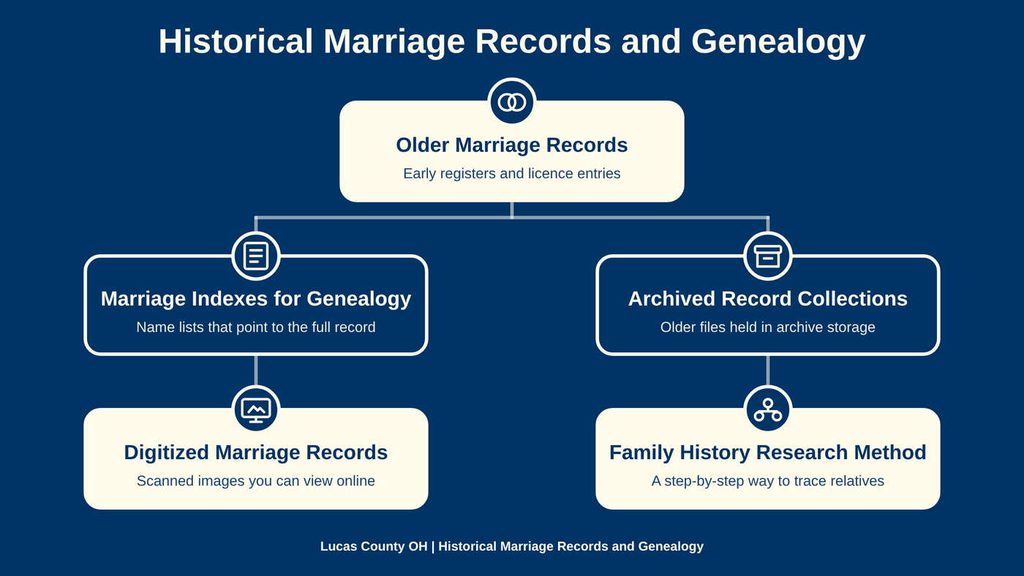
Older Marriage Records
An older marriage may sit in a collection with a narrower year range than the newest records. Searching only the current filing group can produce a false “not found” result. The court can identify the proper historical collection for the year and location you need. Confirm collection coverage before spending hours on repeated searches that may never reach the source you want.
Marriage Indexes for Genealogy
A historical index can serve as a finding aid even when the document image is handled through a separate request. Index entries may preserve a surname spelling, list one spouse under a variant name, or provide a date that helps narrow the collection. Treat those entries as clues. A source image, archived document, or certified copy gives you the stronger basis for recording the marriage in a family tree.
Archived Record Collections
Archived records may use different filters or may not appear in the same result set as recent entries. The archive can also hold images that have been digitized from older files. If a name search produces no match, ask whether the surname appears under another spelling and which archive covers the relevant years. Give the bureau any known record number, exact date, and location so staff can identify the correct collection without a broad duplicate search.
Digitized Marriage Records
A digitized image lets you compare the court’s source wording with a typed index entry. Transcribed names and dates can differ from the image because of spelling, handwriting, or index preparation. Check the image for both spouse names, the event date, the filing location, and any printed record number. If the image and index differ, preserve both versions in your research notes and ask the court which one reflects the official filing.
Family History Research Method
Keep a source log so that later family members can repeat the search and judge each citation. A practical log records what was found and where it came from.
- Record the exact surname and given names shown in each result.
- Save the marriage date, location, and record number without changing their original form.
- Note whether the citation points to an index entry, image, archived document, or certified copy.
- Mark spelling differences and index errors rather than silently correcting them.
- Separate facts taken from the marriage record from conclusions reached through another family record.
Marriage Record Corrections
A correction request asks Lucas County to review the source marriage filing and decide whether an entry should be amended. The requester should identify the exact record and state the proposed change. A search result, family tree, or personal memory can point out a possible error, yet none of those sources changes the court’s record by itself.
Incorrect Spouse Information
Spouse-name errors can involve a misspelled surname, a missing middle name, or names entered in an unexpected order. Compare the index entry with the source document before treating the spelling as a clerical error. A name variation found only in an index may require an archive review. If the source document contains the wrong name, use the correction process described below and request a copy that reflects the court’s decision.
Incorrect Marriage Date
A marriage file can contain several dates, including a date tied to the license process and a date tied to the completed filing. State exactly which date appears wrong and provide the correct value with supporting proof. Do not replace the legal marriage date with a date taken from a family tree unless the court accepts that source. A date correction can affect legal documents, so the request should identify the relevant field rather than merely state that the “date” is wrong.
Clerical Errors and Index Errors
A clerical error affects the source filing, while an index error affects the finding aid used to locate it. The two can occur separately. Correcting an index entry does not automatically amend the source document, and an amended source document may still need a new index entry. Report both parts when you can compare them. The Probate Court can determine which system requires action after reviewing the filing.
Supporting Documentation
Ask the Probate Court which attachments it wants before sending originals or private documents. A clear written request can include the following items:
- The exact record number, if one appears in the search result.
- The spouse names, marriage date, and location shown on the record.
- The current wording and the exact proposed wording.
- A copy of the source record that contains the disputed entry.
- Other dated proof that supports the proposed correction, if the court requests it.
Keep each attachment connected to the requested change. A broad packet of records without labels can make review harder. If a document establishes only part of the claim, identify that limit in the request instead of asking the court to infer the rest.
Amended Marriage Records
An approved correction can appear as an amended entry, an amended copy, or a copy with an amendment notation. Ask which form the court issues after approval. The correction should not be treated as a new marriage or a change referencing verified marriage license records and to the original date unless the court’s order states that result For any later use, confirm that the receiving agency accepts the amended document rather than only the original certificate.
Marriage Record Accuracy and Verification
Accuracy checks matter because a search result can contain a transcription issue, an index variation, or a genuine clerical error. Compare the result with a source document whenever the marriage will support an official request or a permanent family-history citation. The checks below separate the most useful data points and explain what each one can confirm.
Confirming Spouse Identity
A matching surname does not confirm that a result belongs to the couple you have in mind. Compare the given names, middle names, date, location, and record number. If the result shows a shortened name or a spelling variant, compare the remaining fields before accepting the match. For a legal request, the source document or certified copy provides the proper basis for confirming identity.
Verifying the Marriage Date
Check the date field in the source filing against the date used by the index. A result may point to a filing date rather than the ceremony date, so the label attached to the field matters. When two dates appear, document which one the court treats as the marriage date. If the source remains unclear, ask for an authenticated copy instead of choosing a date based on the search display alone.
Checking Record Numbers
A record number is a precise locator for follow-up requests. It helps the Marriage License Bureau find the same filing when names are common or spelled in different ways. Record numbers should be copied without added spaces or punctuation. If a search result and a source document show different numbers, compare the full entries rather than assuming one number belongs to the other filing.
Name Variations
Name variants can include a shortened surname, a different middle name, or a spelling used on one part of the filing. A variation may be accurate even when it looks wrong to the requester. Search for both spouses and compare the supporting fields. If the variation appears only in the index, label it as an index note; if it appears in the source, ask the court whether a correction is needed.
Index Errors
An index error can point to the wrong date, omit part of a name, or place a marriage under a spelling that makes it hard to find. The source document remains the key comparison. If a source file appears sound and the index differs, report the exact mismatch and request the proper index correction. If both differ, request a review of the filing and the index as separate items.
Official Record Verification
Ask the Probate Court to verify a marriage when a search result cannot support the needed claim. Provide the record number, both names, the date, and the location. For document-based proof, request a certified copy and confirm that it matches the result you reviewed. A phone conversation can clarify a record reference, yet the court-issued copy supplies the document that an agency can inspect.
Marriage Record Search Problems
A missed result can come from a name spelling, a wrong date, a separate archive, a recording delay, or an access rule. Each problem calls for a different next step. Work through one variable at a time so you can tell whether the change improved the result.
Record Not Found
An empty result does not prove that a marriage record was never created. Try the other spouse’s name, a wider date range, and known location or record-number details. Check whether the year falls under historical or archived collections. If several precise searches still produce nothing, ask the Probate Court to confirm which collection covers that period.
Name Does Not Match
Search under less common name forms, such as a middle name or a surname without a suffix. Compare both spouses instead of relying on one surname field. A result with a different spelling can still be the correct marriage when the date and location agree. Keep a note of the variation so a later certified-copy request uses the name shown on the source record.
Wrong Marriage Date
If the date is off by a year or falls outside your range, broaden the search and use the spouses’ names with a location. Do not confuse the license date, ceremony date, and filing date. A family tree can carry an estimated date that does not match the court’s source. Treat that as a clue for review rather than a correction to submit without proof.
Wrong County
Search the county connected to the record source rather than choosing a county only from a family address. A marriage license and a recorded marriage are separate filing steps, so residence can differ from the county tied to a particular document. If the location is uncertain, search nearby counties only after checking the official filing link in the source record or asking the Probate Court which county handles the collection.
Historical Record Not Digitized
A marriage can appear in an index even when its full image is not available online. The record may remain in an archived paper collection. Ask the court whether the entry can be supplied through archive handling and what request format applies. Do not describe the marriage as missing from the county’s records based only on an empty image search.
Restricted Record
Some records may have legal or court-controlled limits that differ from the normal request process. A visible search entry does not guarantee that every version can be viewed or copied. If the court withholds a record, ask which restriction applies and whether the request can be reviewed. The Probate Court decides whether a particular copy can be released.
Delayed Record Availability
A recent marriage may be filed before it appears in the searchable index. An older event may also await archive processing. Check whether the date falls within a collection still being organized. If the expected filing has passed, provide the names, date, and known identifiers when asking for a status review. A confirmed filing can still need indexing before it appears online.
Duplicate Marriage Results
Two results do not always represent two marriages. One may be a repeated index entry, or both may describe separate ceremonies involving people with similar names. Compare the full spouse names, dates, locations, and record numbers. If the entries remain ambiguous, request the source documents and ask the Probate Court to explain the relationship between the records.
Public Access, Request Options, Fees, and Processing Time
Searching and obtaining a copy are separate steps. A search locates a source record. The copy-request process decides which version you receive, how you receive it, what you pay, and how long the request takes. Lucas County residents can request a certified or reference copy for legal, personal, or genealogical use, but that statement does not mean every historical source appears instantly in the search.
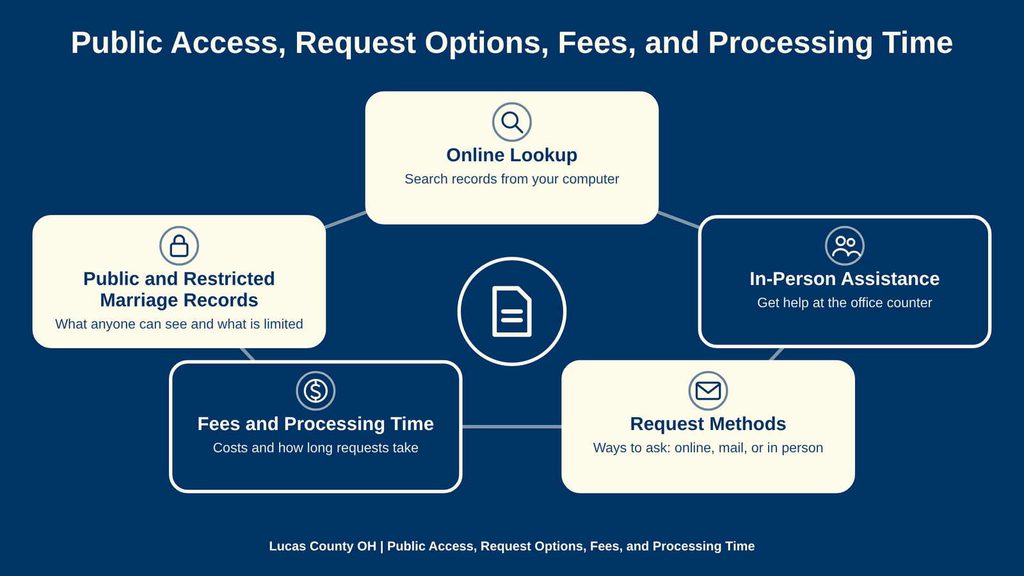
Online Lookup
The official portal supports record lookup by the details available in the filing. Use it to narrow the event and review matching entries before requesting paper or certified output. An online match does not prove that every name and date was typed without error. It also does not guarantee that the record shown is the version accepted by the agency where you plan to use it.
In-Person Assistance
The Marriage License Bureau provides an in-person option for people who need help with a marriage-record request. Bring the exact names of both spouses, the marriage date, the location, and any record number you have found. A clear set of details can help staff identify the filing and explain the available copy choice. Confirm any request form, identification, payment, and collection rules before making the trip.
Request Methods
Online lookup, mail submission, and in-person service are separate methods, and one does not guarantee the others. Use the method named in the court’s current instructions for the chosen copy type. Confirm whether the request can be submitted online, by mail, or in person, and whether payment must accompany it. Do not send records, payment, or private documents until the official instructions match your situation.
Fees and Processing Time
Copy fees and handling periods depend on the document and request method shown by the court. The official details supplied for this page contain no fixed dollar amount or guaranteed turnaround, so no fee or date should be assumed. Before submitting, check the posted copy fee, accepted payment method, delivery choice, expected handling period, and any need for an additional record identifier.
Public and Restricted Marriage Records
The court’s request service does not remove any restriction attached to a particular file. Some entries may require a formal request or court review even though a related index entry can be searched. If a file is unavailable, ask for the reason and the correct request route. This protects the requester from treating a search limitation as proof that the marriage never existed.
Contact Details
Use these official details for questions about Lucas County marriage-record requests and Marriage License Bureau services. The office can provide information about marriage license applications, record availability, and applicable procedures. Contact the department directly to confirm current requirements, fees, and processing times. Check the official county website for updated contact details and service information before making an inquiry.
- Department: Lucas County Probate Court, Marriage License Bureau
- Office location: First floor of the Lucas County Court of Common Pleas, 700 Adams Street, Toledo, OH 43604
- Phone: 419-213-4361
Frequently Asked Questions
Marriage records in Lucas County help you confirm legal unions, trace family history, and obtain certified copies for official use. The records are kept by the Probate Court and can be searched by name, date, or record number. Knowing how to locate and request these documents saves time and avoids costly mistakes.
How can I search Lucas County marriage records online?
Visit the Lucas County Probate Court website and use the online search portal. Enter the spouse’s full name, marriage date, or record number. The system returns matching entries with basic details. Review the results to verify the correct marriage before requesting a certified copy. Online results are not official certificates.
What information is needed to request a certified marriage record copy?
You must provide the full names of both spouses, the exact marriage date, and the record number if known. Include a valid photo ID and a payment method for the fee. Submit the request by mail, in person, or through the court’s online form. Processing typically takes 5‑10 business days.
Can I obtain historical Lucas County marriage records for genealogy?
Yes. The court holds archived records dating back to the 1800s. Search the digitized index on the probate website or contact the clerk’s office for microfilm access. For older entries, request a research copy; it includes the original entry and any marginal notes.
What are the fees and processing time for a Lucas County marriage license search?
The search fee is $5 per inquiry. If you order a certified copy, the cost is $10 plus any mailing charges. After payment, the court processes the request within 5‑10 business days for standard copies. Expedited service is available for an additional $15 and is ready in 2‑3 days.
How do I correct an error on a Lucas County marriage record?
Submit a written correction request to the Probate Court with supporting documents, such as a birth certificate or a court order. Include the record number, the mistake, and the correct information. The clerk reviews the request and, if approved, updates the official record and issues a corrected copy.