
Recent Arrests in Lucas County, Ohio appear on the daily booking sheet each morning, showing the newest booking reports, today’s detention log, and recent mugshots archive for every intake. The list orders names alphabetically, notes the charge description, and links to the latest detainee roster so users can quickly verify current police detentions. This snapshot of recent criminal charges lets neighbors stay aware of safety trends without needing a deep legal background.
Recent Arrests data also feeds the latest arrest database, offering current booking details such as intake time, bond information, and status changes like released or transferred. By checking the daily arrest summary, families and legal counsel can locate a loved one in the latest detainee information and understand recent law enforcement arrests before any court filing. The transparent format supports swift action and community confidence.
How to Search Recent Arrests
Recent arrests in Lucas County, Ohio are published through the daily booking sheet on the Lucas County Sheriff’s Office Corrections Center page. The sheet is the jail’s public intake list accessible through official arrest lookup portals and and searching it helps a reader confirm whether a person has been booked, what the recorded charges say, and where the person stands in the custody process Families use it to locate a relative, attorneys use it to check a detention, and members of the public use it to follow local arrest activity. The sheet captures what staff recorded at the jail, not the complete case file kept by the court.
Official Search Portal: https://lucascountysheriff.org/corrections/corrections-center
Steps to Search
- Open the Corrections Center page on the Lucas County Sheriff’s website and find the booking sheet section that publishes each day’s intake list.
- Select the most recently posted sheet, since each morning’s posting carries the previous day’s bookings.
- Scan the alphabetical detainee roster and locate the person’s full name.
- Read the entry for the booking date, booking time, charge summary, and custody status, then open the linked booking photo if the row includes one.
- If the name is absent or the row looks wrong, check the prior day’s sheet and use the contact options listed at the end of this page for help with corrections.
What Counts as a Recent Arrest
Ohio law does not use recent arrest as a formal category. On the Corrections Center sheet, recency simply means the booking was posted within the current or recent intake listings. A name on the sheet shows that police took the person into custody and the jail processed the intake. It says nothing about how long a case may last or what a judge decides later. The sheet works as a practical arrest database for recent Lucas County intake.
Newly Reported Arrests
A newly reported arrest appears when a posted sheet includes the person’s booking. Police can arrest someone under a warrant or under a legal exception that permits an arrest without one, and the jail takes custody after that event. The date and time on the row mark the jail’s intake, which can run hours after the arrest itself. That gap explains why a late-night arrest may still be missing from the sheet a reader checks first.
Recent Booking Entries
A recent booking entry is a row describing one stay at the Corrections Center. It ties a name to a booking number, a booking date, the charges recorded at intake, and the status of that stay. The booking number is the jail’s own reference point, which lets staff match a caller to the correct record when several people share a name.
Current and Recently Released Individuals
The daily sheet can still show a person who has left the jail. A release does not erase the booking row, since the row records the stay rather than the current location. Anyone checking present custody should read the status field next to the name before drawing a conclusion about where the person is.
Time Limits for Recent Arrest Listings
The daily posting centers on recent intake, so older arrests fall away as new sheets replace them. The sheriff’s website also posts a monthly PDF that compiles daily booking sheets, giving a longer view of Lucas County arrest activity across a full month. An arrest from several weeks back may need that compilation or a direct request to the jail rather than the newest sheet.
Charges Listed After an Arrest
The charge line on a booking sheet records recent criminal charges as they were entered when a person was booked. Each line points to a section of Ohio criminal law and carries a short description of the conduct alleged. These lines stay pending until the court resolves them.
Offense Name
The offense name is the label for the law tied to the arrest, drawn from the criminal statute or ordinance cited at intake. One label can cover many different behaviors, so the name by itself rarely tells a reader what happened. It functions as a sorting tool for a long list of names.
Charge Description
The charge description gives a brief summary of the conduct alleged. It exists so readers can scan rows without opening a court file. The wording is short, written for a booking screen, and may not match the legal language used in a later court filing.
Charge Classification
Ohio divides crimes into felonies and misdemeanors. A felony can carry a prison sentence of more than one year, and a misdemeanor can carry up to one year in jail. A classification on the sheet describes the charge as filed at booking, not a sentencing decision, and a person booked on a felony charge has not been found guilty of it.
Multiple Charges
One booking can carry several charge lines. Each line stands on its own as a separate allegation, so five charge lines mean five open allegations rather than five convictions. A line can also be added or removed as the case moves forward through the court process.
Bond Information
The bond line shows what a person must meet to leave custody. At the first appearance before a magistrate, the court sets bond or orders the person held without bond. Later, a cash bond, a recognizance bond, or other court conditions can apply, and the sheet shows whether a bond was posted.
Recent Arrest Processing
An arrest passes through several steps before a name shows up on a booking sheet. Each field on a row maps to one of those steps, which explains why some details change later and why the booking time can look late for an arrest that happened earlier.
Initial Arrest
The arrest comes first. Police detain a person under a warrant or under a legal exception that allows an arrest without one, and the person stays in police custody until the jail takes over. The booking time on the sheet reflects the jail’s intake rather than the moment officers first took the person into custody.
Booking
Booking is the jail’s intake step. Officers record the arrest details, the charges, and personal details such as name, date of birth, and address. A booking number is assigned at this stage and stays attached to that stay in custody.
Identification and Intake
Intake creates the identifiers used on the roster. A booking photo, physical description, and fingerprinting give the jail a way to tell one person from another. These identifiers help staff confirm that a caller asking about a detainee is asking about the correct person, and they support matching the booking to later court records.
Bond Determination
The bond decision comes through the court rather than the jail’s front desk. At the first appearance before a magistrate, the court sets bond or holds the person without bond, and the jail follows that order. Until that appearance happens, the person stays in custody.
Release or Continued Custody
Custody can end in several ways. The person may leave after posting bond, leave on the court’s own recognizance, or leave when the case concludes. If the case remains open, the person stays in custody and moves toward a court date. The status line shows which path the booking has taken.
Transfer to Another Facility
A booking can end with a move rather than a release. A person may transfer to another county jail, a court-ordered facility, or a state prison after sentencing. Once the transfer happens, the Corrections Center row shows a transferred status and custody continues elsewhere.
Current Status of Recent Arrests
The status field on a booking row tells where the person stands. It changes as the case moves, so it should be read as of the date shown on the posting. For readers tracking current police detentions, the status field does the work that the name alone cannot do.
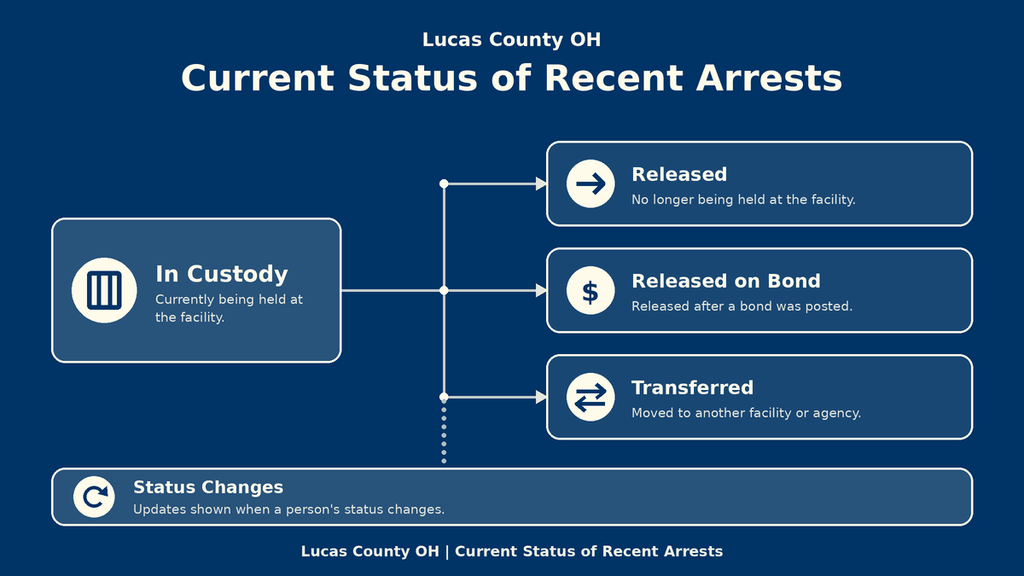
In Custody
In custody means the Corrections Center held the person as of that posting. It confirms that the jail holds the person and says nothing about how long the stay will last.
Released
Released means the person left jail with no bond still pending. A release can follow a court decision, a dismissal, or a negotiated resolution, and the booking row remains visible to preserve the record of the stay.
Released on Bond
Released on bond means the person met the bond terms and left the jail while the case stayed open. The person can owe money, appear at later court dates, and stay subject to court conditions. A bond release does not cancel the charges.
Transferred
Transferred means the person left Corrections Center custody for another facility. The booking row records the handoff, and later updates come through the receiving agency.
Status Changes
A row can move from in custody to bond release, then to full release or a transfer. A later posting or a direct check can confirm the newest position accessible through official arrest records databases and since a change made after the sheet went out waits for the next update
- Read the posting date beside the status line, since a change made after posting appears on a later sheet.
- Pair the status with the charge line, since a bond release next to open charges means the person is out while the case continues.
- Treat a transferred status as a handoff, and ask the receiving agency where the person is held.
- Treat a missing status value as unresolved, and check the booking line listed at the end of this page.
- Use the booking number as the identifier when confirming a record with a third party.
Recent Arrest Data Updates
The daily arrest summary is a working record, so entries change from one posting to the next. Knowing the type of change helps a reader work with the newest booking snapshot without guessing at what a row means.
Newly Added Entries
Each morning’s posting carries the previous day’s intake, so names arrive in a batch rather than one at a time. A person booked late in the evening may not appear until the next morning’s sheet. For a detention that happened overnight, the newest sheet is the first place to check.
Delayed Arrest Listings
Some entries post later than others. Intake processing, a transfer of data between agencies, or a correction to the booking record can push a name to a later sheet. A missing name on the current sheet does not prove that no arrest occurred.
Updated Charge Details
Charge lines can be added, changed, or removed after the first posting. Prosecutors add a charge, a court resolves one, or the allegations narrow as the case moves forward. The newest version of the row shows the case as it stood when the sheet was prepared.
Updated Custody Status
The status line changes when a person leaves or changes custody. A bond posting, a court order, or a transfer can turn an in-custody row into a released or transferred row. The posting date matters, since a change made after the sheet went out waits for the next posting.
Corrected Entries
Corrections happen when staff catch a typing mistake, a spelling variation, or a wrong date or time. A corrected row can look different from the row a reader saw earlier. The booking number stays the cleanest way to confirm that two rows refer to the same stay.
Removed or Archived Entries
Older arrests move out of the current posting as new sheets arrive. A name missing from the newest sheet may still exist on an earlier sheet or in the monthly compilation of daily booking sheets. That monthly PDF gives a broader count of Lucas County arrest activity over a full month, which helps with review and comparison of recent police record updates.
Limits on Recent Arrest Records
A booking sheet is a snapshot of jail activity, and several limits shape what a reader can learn from it.
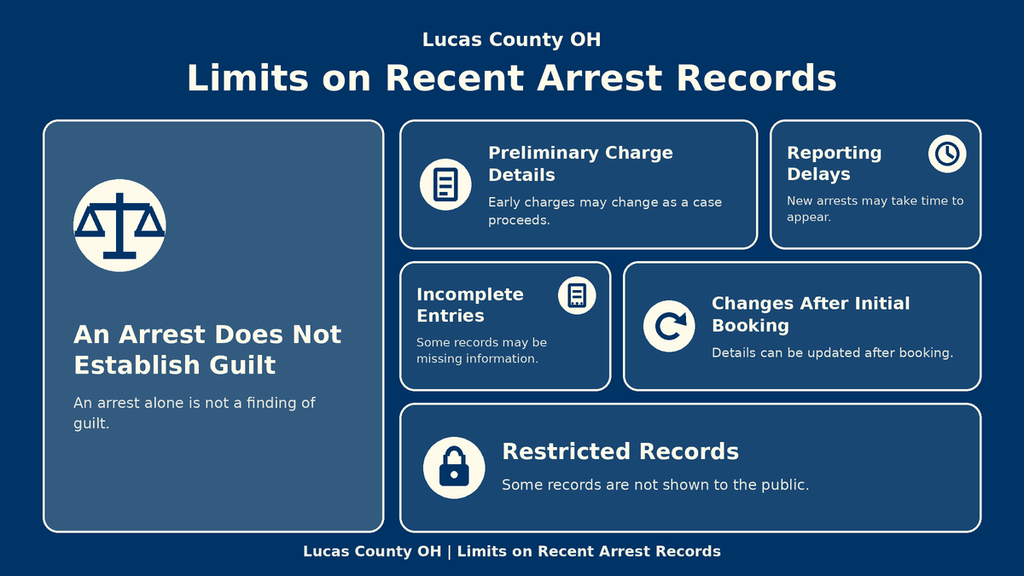
An Arrest Does Not Establish Guilt
An arrest means police took someone into custody. It does not mean the person committed the act charged. Ohio law presumes a person innocent until a court finds guilt beyond a reasonable doubt, so every charge line should be read as an allegation awaiting a court response.
Preliminary Charge Details
The charge summary reflects what was recorded at intake. The complete case file sits with the court, where filings and hearings build the full record. Booking text can be shorter than the legal complaint, and it can change as the case develops.
Reporting Delays
Arrests happen around the clock, while postings follow a schedule. A booking from the night before may appear on the next morning’s sheet, and a delayed entry can miss a posting entirely. When a reader needs certainty about one detention, a direct check with the jail carries more weight than an earlier sheet.
Incomplete Entries
Some rows have gaps. A charge may carry a general label without the facts behind it, or a personal detail may be incomplete at intake. Staff fill in missing details as the process moves along, so the first posting often carries the fewest facts.
Changes After Initial Booking
A booking row is a starting point rather than a finished case. Charges, status, and location can all change after intake, which means a row saved weeks ago may no longer match the current record.
Restricted Records
Some records never reach a public booking sheet. Juvenile matters and court records sealed or expunged by a judge fall under court rules rather than the daily intake list. A person who does not appear on the sheet may have been booked somewhere else or may have no booking at all.
Search Problems and What They Usually Mean
Most failed searches on a booking sheet come from ordinary causes rather than a missing record. The table pairs each common problem with the check that resolves it.
Arrest Not Yet Listed
Intake and posting happen at different times. A booking can be complete while the name waits for the next morning’s sheet. Checking the newest posting and then the one before it covers most of that gap.
A Name Match Fails
Names on the sheet may be entered differently from the name a family member knows. A middle initial, a shortened first name, or a spelling variation can block a match. Searching part of the name and reading the surrounding rows helps confirm a match.
Duplicate Names
Two people can share a full name, and each receives a separate booking number. The booking number, date, time, and charge summary separate the two records. When a caller is unsure which row applies, those fields supply the detail that narrows the search.
Incorrect Booking Details
Spelling and data errors happen at intake. A later posting can carry the corrected row. Staff can also confirm the right details when a caller supplies the person’s full name and date of birth.
The Arrest May Sit With Another Agency
A Lucas County arrest does not always mean a Lucas County Corrections Center booking. Police may hold someone temporarily, move the person to another county jail, or book the person into a facility outside the county. The sheet covers intakes at the Corrections Center in Toledo, so custody elsewhere needs a check with the agency holding the person.
A Released Person Still Appears
The booking row stays on the sheet after release because it records the stay, not the current location. The status line carries the answer, and a change made after the posting waits for the next sheet.
An Older Arrest No Longer Appears
The current sheet covers recent intake only, so an arrest from weeks or months back drops away. Earlier postings and the monthly compilation hold those entries. For a full history, ask the Corrections Center which records they can provide for that period.
Contact Details
The Lucas County Sheriff’s Office Corrections Center handles questions about people booked into the Toledo facility and about the jail’s services. The booking line covers questions about a detention, the Corrections general line covers broader corrections questions, and the Commissary Office handles commissary business. The Inmate Services Office and the Commissary Office keep separate weekday hours.
Frequently Asked Questions
Lucas County’s daily booking sheet lists every person placed in custody. It lets families see if a loved one is held, helps attorneys confirm charges, and gives the public a clear view of recent arrests. The sheet updates each day, so users always get the latest detention details.
How can I find recent arrests in Lucas County?
Visit the Lucas County Sheriff’s Corrections Center page and open the daily booking sheet. Look for the name column, then read the charge and booking date. The sheet shows the exact time of intake, the booking number, and the facility location. Use the search box on the page to narrow results quickly.
Where are the newest booking reports posted?
The newest booking reports appear on the sheriff’s website under “Daily Booking Sheet.” They are posted each morning after the shift ends. A link labeled “Latest Arrests” directs you to a PDF or HTML list that can be downloaded or printed for record‑keeping.
What details are included in today’s detention log?
The log lists each detainee’s full name, age, booking photo, charge description, bond amount, and release status. It also shows the arresting agency and the case number. This information helps callers verify identity and understand the legal steps ahead.
How do I check recent criminal charges for a specific person?
Find the person’s entry on the booking sheet, then read the “Charges” column. Each charge includes a code and a short description. For deeper details, call the Corrections Division at 419‑213‑4945 during office hours. They can confirm bail conditions and upcoming court dates.
Can I get a copy of the latest detainee roster for legal work?
Yes. Click the “Download PDF” button on the booking sheet page. The file contains the full roster with all required fields. Attorneys can use it to prepare motions, contact the inmate services office, or schedule a visitation. The office is open Monday‑Friday, 8 a.m.‑4 p.m.