
Jail Records enable families, attorneys, and investigators to locate custody details within seconds. Our jail records search taps a public jail records database that aggregates county jail records, detention center entries, and correctional facility information. Users can find jail records online without fees, view booking dates, and verify inmate identity through a reliable jail records lookup. The system updates quickly, so recent intakes appear in the online directory almost instantly.
Jail Records by name, booking number, or date let you pinpoint a specific case in the jail record database. The platform returns inmate housing location, charges, bail amount, and custody status, supporting quick verification of jail history and records custody records. For historical queries, the jail record finder includes archived entries, making it easy to track transfers, discharges, and past bookings across multiple correctional facilities.
How to Search Jail Records
Jail records document bookings and custody events for people held by a jail or detention facility. A jail records lookup can help a family member, attorney, or other authorized requester locate a booking number, custody status, housing location, charges, bond details, or a transfer or discharge date. The lucas county oh Sheriff’s Office Corrections Center page is the official starting point for Lucas County custody questions. An online result works best as a current lead, and requests needing confirmation should be checked with the booking office.
Official Search Portal: Lucas County Corrections Center: https://lucascountysheriff.org/corrections/corrections-center
Steps to Search
- Open the official Lucas County Corrections Center page and locate the current inmate lookup, jail roster, or inmate-services link published there.
- Enter a full legal name, booking number, or booking date in the record-search service linked to this page. Use the narrowest field the person can supply.
- Review each match with the booking number, booking date, and custody status. A name alone cannot separate people who share the same name.
- Open the matching entry and note the record date, housing location, charges, bond or bail details, and transfer or discharge event shown.
- Use the booking general line in the contact section when a copy, correction, or case-specific custody check is needed.
A booking number usually offers the narrowest match because it points to a specific jail intake event. A full legal name is useful when no booking number is known, while a booking date can reduce a large group of people with similar names. The search options described on this page support name, booking-number, and date queries across current and historical entries. The online directory may combine records from county jails, detention centers, and correctional facilities. Exact fields and refresh timing depend on each source agency. An entry marked inactive can still represent a completed booking, and a historical result can show movement that a current roster omits.
Inmate and Facility Details
A useful jail record separates identity details from custody events. A booking number identifies an intake event, housing records describe placement, charges and bond records provide legal context, and transfer or discharge entries trace movement. Reading each part for its actual purpose prevents a roster summary from being mistaken for a complete case file.
Subject Identity and Booking Numbers
On a jail listing, a booking number identifies one intake event at the jail. It is not a court case number. One person can have several bookings for separate intake events, so two booking numbers do not by themselves mean two different people. A court case number can also cover several jail bookings or court appearances.
Names can change, and a source may list a nickname, alias, suffix, or spelling variation. Search the exact recorded spelling first, then try a small number of plausible variants and check the booking date. Do not combine two rows solely because the names look similar.
Active Custody and Housing Location
Active custody means the source lists a person as held when the record was posted. It does not prove a charge, a sentence, or the outcome of every related case. A housing location may name a facility, unit, cell, or another placement category. That location can change after a transfer, court order, intake step, or release.
Current location, legal custody status, and physical placement may not be identical in every record. Some directories preserve a former housing location beside the latest status. Compare the record date before drawing a conclusion about where a person is held.
Booking Charges, Bail, and Bond
Charges shown during booking state the alleged basis for the intake. A booking entry may omit later amendments, dismissed counts, added charges, or court decisions. The official court docket remains the proper source for filed charges, bond conditions, filings, and case disposition.
Bond or bail details may show an amount, a posted status, or no posted amount. A figure on a jail listing does not by itself prove that the bond was paid, stayed, modified, or satisfied. For a current amount or status, compare the jail entry with the court case under its court case number.
Facility Transfers and Discharges
A transfer entry records movement from one jail or correctional facility to another. The receiving agency may create a new booking or case identifier, so a historical search can require the person’s name and transfer date in addition to the first booking number. An online jail record finder can then connect the movement across source systems.
A discharge marks the end of detention at the facility that posted it. The reason may not appear on a summary roster, and the discharge can correspond to a release, transfer, or another legal event. Ending jail custody does not erase the booking or prove that every related court case has ended.
Public Availability and File Requests
Public availability depends on the record type and the law that governs it. Ohio Revised Code §149.43 requires public offices to make public records available subject to specific exceptions. Jail rosters, booking files, incident reports, medical records, personnel records, and court records serve different purposes and can have different disclosure rules.
An online directory can help locate a person or event, while a records request asks the record custodian for an existing file. The directory may show selected fields from several sources, but it does not replace the custodian’s response to a formal request. A records request cannot create a record that never existed, so the request should describe a specific person, date range, and record type.
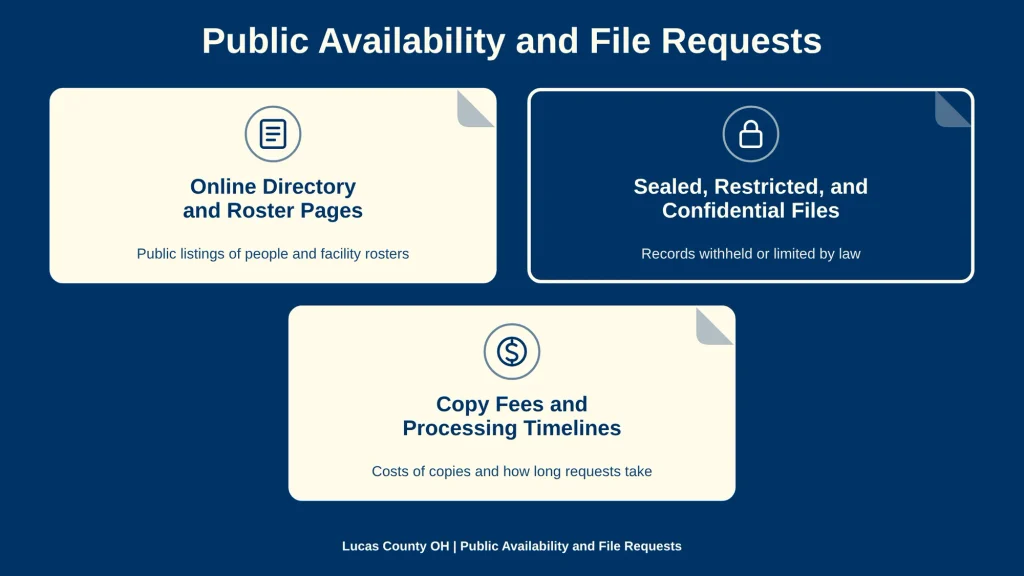
Online Directory and Roster Pages
The right source depends on the fact being checked. Use a current roster for present custody accessible through official jail roster listings and a booking entry for intake details, a historical record for prior movement, and a court docket for the formal case A combined search can present several record types, yet each result should still be traced to the agency that holds it.
- Current inmate roster: Lists people shown in custody at a stated update time, often with a booking number, booking date, and housing location.
- Booking entry: May show the booking reason or charges, bond amount, custody status, housing location, and intake date.
- Historical booking entry: Can show prior bookings, transfers, discharge dates, and the sequence of custody events.
- Consolidated history: May combine entries from several jail, detention-center, or correctional-facility sources. Coverage depends on each source and its refresh cycle.
- Court docket: Shows filed charges, bond conditions, court filings, and case disposition under the court case number.
Directory coverage can vary by source agency and date. A missing row can mean that the search fields did not match, the person was booked by another agency, or the source has not posted the event. It does not prove that no booking exists. A jail records search by date can reduce these false conclusions when a person remembers only the month or year of an arrest.
Sealed, Restricted, and Confidential Files
Ohio Revised Code §149.43 lists exceptions that can protect an entire record or particular fields. For a jail-related request, exemptions may apply to juvenile matters, medical details, personnel materials, investigative police reports, or records covered by another state or national statute. The result depends on the requested material and the facts of the file.
A request for a person’s current custody status is narrower than a request for every record concerning that person. Identify the exact report, booking sheet, property record, disciplinary entry, or other item sought. Ask the agency to separate disclosable portions from material claimed to be exempt when the law permits that separation.
If a request is denied, ask for a written decision that identifies the statutory basis and the available appeal steps. Ohio law provides a route for a denied requester to challenge a public-records decision through the county prosecutor. Keep the written response with the request so the decision date and stated reason remain clear.
Copy Fees and Processing Timelines
Ohio law sets cost-based limits for standard public-record copies and permits a public office to require payment before delivery. Fees for electronic media, certified copies, postage, or a compilation may follow separate rules. The published Lucas County contact details do not list a current copy amount or processing period, so neither should be assumed before a request is accepted.
Ask for the current fee, payment method, delivery charge, processing estimate, and certification options. A written request should name the agency, the subject, known aliases, the booking number or date range, the record type, and the preferred delivery method. Include only sensitive data that the requester lawfully holds and that the office needs to locate the correct file.
A printed roster entry is not a certified copy. A certified document must come from the custodian of the underlying record, while a certified court document comes from the clerk of the court. Some jail records may be supplied as ordinary copies without a certification option, so ask about that distinction before relying on a document for a legal filing.
Record Accuracy and Resolution
Accurate lookup depends on matching the right person to the right booking event. Search tools can contain spelling differences, delayed updates, duplicate entries, and records from more than one source. A documented search process helps reveal those issues instead of treating a missing or conflicting result as a final fact.
Name Matching and Identity Verification
Names are not unique, and a person may be booked under a legal name, another name, or a name that has changed. Start with the booking number when one is available. A booking date offers the next strongest filter, followed by a full-name search with known spelling variations.
Compare the booking number, booking date, custody status, and housing location before accepting a match. A citation number or court case number may help the booking office locate the event, but it does not replace a jail booking number. Give both numbers when known so staff can connect the court event with the correct intake.
Ask the agency to confirm identity before a request is attached to the wrong booking file. A date of birth, address, government identification number, or another known identifier may assist that check, but the requester should share such data only when there is a lawful need. Identity matching confirms which record belongs to the subject; it does not establish the merits of the charges.
Intake and System Delays
New bookings, transfers, releases, and status changes can occur before a directory refreshes the affected row. A source may also update each type of record on a different schedule. The date shown with a result matters because a status label can describe the moment the source posted the entry rather than the exact time of the underlying event.
Do not assume a fixed refresh interval unless the source displays one. When current custody matters, repeat the search using the booking number or a narrow date range, note the search date and time, and ask the booking office to confirm the status as of that moment. A written confirmation can be useful when later records show conflicting dates.
A missing online entry can result from an alias, spelling difference, recent intake, discharge, or a source that does not feed the directory. It can also mean the person was booked by a different agency. Court records can support a custody check, but court status and jail custody remain separate facts.
Unlisted Inmate File Resolution
When no match appears, begin with the exact legal name, known suffix, and likely spelling variations. Search one specific date before widening the range, then search the full month or year. If a court notice, release paper, or citation supplies a number, provide it to the booking office and state that it may differ from the booking number.
If the directory still has no row, request a date-limited custody check and ask the Corrections Division to search its records for a named person, known date range, and possible aliases. Keep a written record of every search term, date, time, and result. That log can help staff narrow an earlier search that used incomplete identifiers.
If the official source finds a clerical error, ask how the correction will be recorded and whether written confirmation is available. A saved screenshot proves only what a search page displayed at one moment; it cannot authenticate the underlying record. For a sworn statement, affidavit, or certified document, ask the issuing custodian what form it can supply.
Contact Details
Use these official Lucas County contacts for facility questions, booking confirmations, and case-specific record requests. Questions about a particular booking fit the booking line, while questions about the Corrections Division can be directed to its listed number. The posted weekday schedules do not list holiday exceptions. Confirm a visit or request during the applicable office hours before traveling to the facility.
Frequently Asked Questions
Jail records give a clear view of bookings, charges, bond amounts, and release dates. Accessing this data helps families, lawyers, and researchers verify custody status quickly. The Lucas County Corrections Center offers online tools and phone lines to locate records by name, booking number, or date. Knowing where to start saves time and reduces uncertainty when dealing with detention information.
How can I search Lucas County jail records by name?
Visit the Lucas County Sheriff’s website and locate the Corrections Center page. Enter the full name in the online search box, then click Search. Results show booking number, charge details, housing unit, and bond amount. If the name does not appear, call 419‑213‑4962 for assistance. This method works for current and recent inmates.
What steps are needed to find jail records using a booking number?
Begin at the official Lucas County Corrections Center site. Choose the “Booking Number Lookup” option and type the ten‑digit number. Press Submit to view the inmate’s profile, including intake date, charges, and projected release. For older bookings, request a copy by calling 419‑213‑4425 and specify the record date.
Can I locate county jail records online for a specific date?
Yes. The online portal includes a date filter. Select the desired day from the calendar, then run the search. The list displays every booking processed that day, with links to each record. This feature assists journalists and researchers tracking trends in detention.
What phone numbers help with jail record lookup if the website is down?
Call the Corrections Division at 419‑213‑4945 for general inquiries. For booking details, dial 419‑213‑4962. The Inmate Services Office (8 a.m.–4 p.m.) can also verify records and guide you through the request form. Having the inmate’s name or booking number speeds up the call.
How do I obtain historical jail records for legal research?
Submit a written request to the Lucas County Sheriff’s Office. Include the inmate’s full name, known booking dates, and purpose of the request. Send the letter to 1622 Spielbusch Avenue, Toledo, OH 43604. The office may charge a small copying fee and will return the documents by mail or email.