Public Records serve as the backbone for anyone needing a free public records search, from homeowners checking property deeds to employers running a background check. The new public records portal simplifies how to obtain public records, offering a clear fee schedule and instant access to court cases, marriage licenses, and criminal history. Users appreciate the transparency of the public records request form and the ability to retrieve data without hidden costs, making research swift and reliable.
Public Records empower citizens to verify information, protect privacy, and support genealogical projects through a robust public records digital archive. By leveraging public records compliance guidelines, researchers can navigate archives, discover sealed records exceptions, and request certified copies via the official Lucas County clerk’s policy. The portal’s user‑friendly design ensures that both journalists and everyday users can quickly locate the exact document they need.
How to Search Public Records
Public records are official documents and data held by government offices. A Lucas County public-records search can help you locate court filings including verified lucas county oh resources and deeds, birth and death records, probate files, marriage records, and administrative records The right source depends on the office that created or keeps the file. Start with the record type and the maintaining office, since one county portal may not cover every record.
Official Search Portal: https://www.lucascountyoh.gov/3742/Public-Records-Request-Policy
Steps to Search
- Identify the record you need and list the strongest matching details, such as a full legal name, case number, parcel number, document number, event date, and jurisdiction.
- Open the Lucas County Clerk of Courts policy and follow its routing instruction to find the county office that maintains the requested file.
- Use that office’s official search tool when it offers one, entering only details that match the indexed record.
- Review the record type, court or township, date, party, and property details before requesting a copy.
- If the online result is missing or incomplete, send an official public-records request form with the needed identifiers, date range, copy format, and delivery choice. Ask for the fee and payment method before placing a paid order.
Lucas County OH Public Record Categories
Public records in Lucas County fall into several legal and operational groups. The office that maintains a file controls its search method, copy charges, and disclosure rules. Some categories also involve state agencies, municipal court clerks, or federal record systems.
Property and Land Records
Property research often requires both a title document and a tax record. The Lucas County Recorder holds recorded deeds, mortgages, and other instruments, while the Auditor supplies parcel and valuation data. Tax offices maintain payment records. A tax balance answers a different question from ownership, and neither a parcel listing nor a tax screen replaces a recorded deed or a title opinion.
Court and Case Records
Depending on the docket, useful search fields can include a case number, party name, case type, filing date, and court location. Once you find a case, review the docket entries and disposition instead of relying on the case title alone. A party’s name may appear under several formats, including a full legal name or a shortened court index name.
County, municipal, and federal cases
A county court case does not cover every case involving people in Lucas County. Municipal court matters may belong to the clerk for the city or other municipality, and federal cases belong to a federal court system. Federal docket records also use a separate paid search service rather than the Lucas County Clerk of Courts system.
Criminal and Police Records
A criminal court file shows the charges, filings, and court outcome for one case. It may not show every arrest, traffic stop, police report, or federal conviction. A statewide criminal-history search and local police records come from different systems, so a full background check may require several lawful sources.
What a background check can show
A court disposition can confirm that a case was dismissed, settled, or convicted. It does not by itself create a complete criminal history, and it may omit juvenile matters, sealed cases, federal records, or records outside Ohio. A report produced by a private screening company is not the same as an official court file, and employment decisions may require consent and consumer-report rules beyond public-records law.
Birth and Death Records
Birth and death certificates are handled through the local registrar or vital-records office and the Ohio Department of Health, depending on the service requested. A file search often needs the person’s full name, date of birth or death, place of event, and parents’ names. Records for some recent events may be awaiting processing before an online certificate appears.
Marriage and Divorce Records
A marriage license shows that the county issued permission to marry. A marriage certificate usually confirms that a ceremony took place and states the date, so the two documents serve different purposes. Divorce records remain part of the court case and include the petition, orders, and final decree.
Probate and Estate Records
Probate dockets track the opening of an estate, appointment of a fiduciary, inventories, claims, distributions, and closing orders. A probate case may connect to a deed filed after death, yet those documents remain separate files. Some probate material has statutory protections, and the court may hold the original will under its own custody rules.
Business Records
Most legal entity filings sit with the Ohio Secretary of State rather than a county office. The official Ohio business search at https://businesssearch.ohiosos.gov/ can help locate formation records, status details, registered offices, and filing images. A county recorder may hold a separate deed, mortgage, or local instrument tied to a business property.
Government and Administrative Records
Department and board records cover a wide range of public business. Useful files can include meeting minutes, budget documents, contracts, permits, policies, grant records, and correspondence. Personnel and personnel evaluations can contain exempt material, so a request for a complete personnel file may produce a redacted version rather than every page.
How Public Records Are Created
A public record enters the system when a government office creates it or receives it and keeps it. Ohio law defines public records in relation to public offices, subject to listed statutory exceptions. A record may exist as paper, an electronic file, a database entry, a scanned image, or an audio recording. Search indexes are built from those source files, and an index entry is not the same as the complete official record.
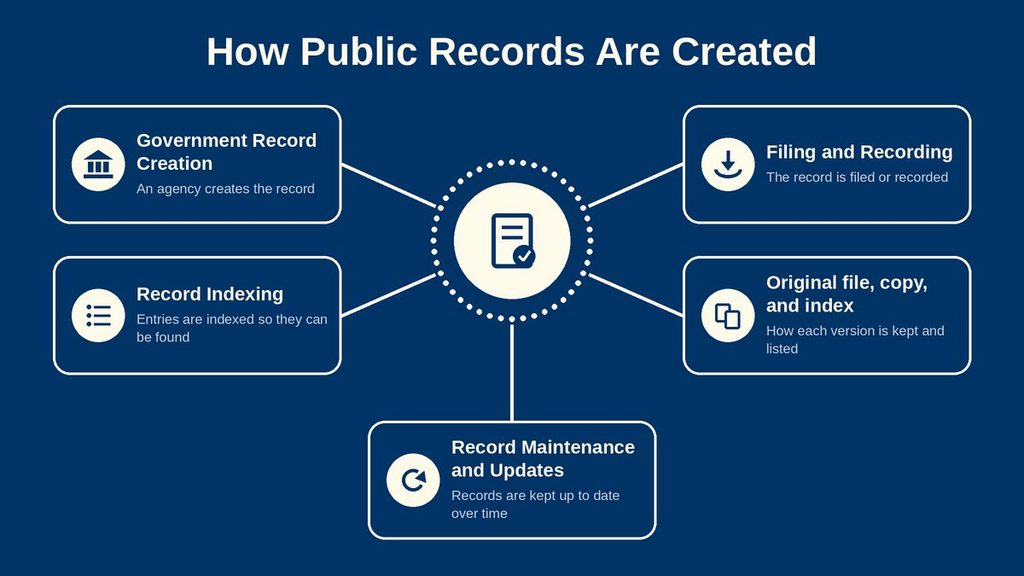
Government Record Creation
Daily government work produces records such as case filings, property instruments, licenses, certificates, meeting minutes, budgets, contracts, and inspection reports. A document created outside a public office can also qualify when the office receives and keeps it. The agency’s role in creating, receiving, or maintaining the record helps determine where a request belongs.
Filing and Recording
A clerk or recorder receives the document, records basic filing details, assigns or confirms a case or recording number, and places the document in the proper file. Recording creates a public copy for the relevant docket or land register. The filing date, event date, and recording date may differ, which matters when searching by time.
Record Indexing
Indexers pull names, dates, numbers, parties, document types, and descriptions into a searchable format. Optical character recognition can create searchable text, but a scan can produce errors in spelling, dates, or numbers. Manual review may correct some entries, yet other mistakes can remain in the index for years.
Original file, copy, and index
The filed or recorded document is the authoritative source for its contents. A digital image serves as the displayed copy, while the index acts as a finding aid that points to the document. If an index entry conflicts with the document image, ask the custodian for the source copy and a certified copy when the record will be used for an important decision.
Record Maintenance and Updates
Public offices maintain records through filing, imaging, correction, amendment, retention, and transfer processes. A later order may change a court case without replacing every earlier filing. A digital index can also be corrected without changing the stored document, so ask the office which part of the record has been changed.
Public Record Costs and Processing
Cost depends on the service requested. Many indexes are available with no charge, while copies, electronic media, certified copies, delivery, or staff-assisted retrieval may carry fees. Local offices set their own fee schedules, so use the price supplied by the maintaining office rather than a third-party estimate. The controlling state statute is Section 149.43 of the Ohio Revised Code: https://codes.ohio.gov/ohio-revised-code/section-149.43
Search, Copy, and Certification Fees
Ask what each service includes before ordering. A plain electronic copy, a printed page, and a certified copy are different products with different purposes. Ask for a total estimate based on the number of records, pages, images, and delivery choices requested.
Request Processing Time
Ohio law requires a public office to make reasonable efforts to respond to a request within ten business days after receiving it. A large or complex request may require a reasonable amount of additional time. Reviewing confidential content, redacting exempt material, locating paper files, scanning images, and waiting for payment can affect the actual completion date.
An informal lookup through a public index may not count as the formal request that starts the statutory response period. Ask the office how it wants requests submitted and what makes a request complete. If a search produces no result, tell the office that you are making a records request rather than an inquiry for an existing file.
Payment Requirements
Ask which payment methods the office accepts, who receives the payment, and whether payment must arrive before work starts. Keep a copy of the request, receipt, and payment record. A quoted estimate can change if the requested date range or number of records expands, so request approval before adding substantial material.
Public Record Availability and Restrictions
Ohio’s public-records framework treats records as public unless a statutory exception or valid court order applies. An office reviews requested material against the law and may release ordinary content while redacting exempt passages. Some exceptions support withholding the full record. A request can seek exempt material, but the office must review it and give a written response that states the reason for any denial.
Public, Exempt, Sealed, and Redacted Records
Different labels describe different legal situations. A record can be available online, restricted in part, sealed by a court, or absent because it has not yet been filed. Knowing the label helps you decide whether to file a new request, ask for a redacted copy, or pursue a court process.
Request Fields That Prevent Delays
A request should identify the requester, the office holding the record, the record type, and the smallest workable set of identifiers. Include a case or document number accessible through official court records databases and full names, event date, date range, jurisdiction, and known spelling variants State whether you need a plain copy, an electronic image, or a certified copy, and explain any requested delivery method.
Use the maintaining office’s official public-records request form when one is available. Broad descriptions such as “all records about a person” can create avoidable review and production work. A narrower request that names a case, parcel, document type, and time period is easier to process.
Privacy and Background-Check Use
Public status does not remove privacy consequences. A file may contain home addresses, signatures, medical details, family data, or information about minors. Use official records for a lawful purpose, protect the data you receive, and avoid republishing sensitive details that serve no proper purpose. For a background check, distinguish an official case outcome from a private screening product and follow consent rules that apply to the intended use.
Denials and Written Review
If the office denies a request or withholds part of a record, ask for the decision in writing, the legal basis, and the appeal procedure named in that response. A partial denial may identify redacted passages and explain the exemption. For a sealed court file, the court may need to receive a motion or another legal filing before the file can be opened.
Historical Lucas County OH Public Records
Older records may be held by the Lucas County Archives, a county office, a municipal court clerk, a state agency, or another repository. Online indexes often cover newer files more fully than older files. The age of a record does not prove that it was destroyed, since retention schedules and transfers can move records outside the current search system.
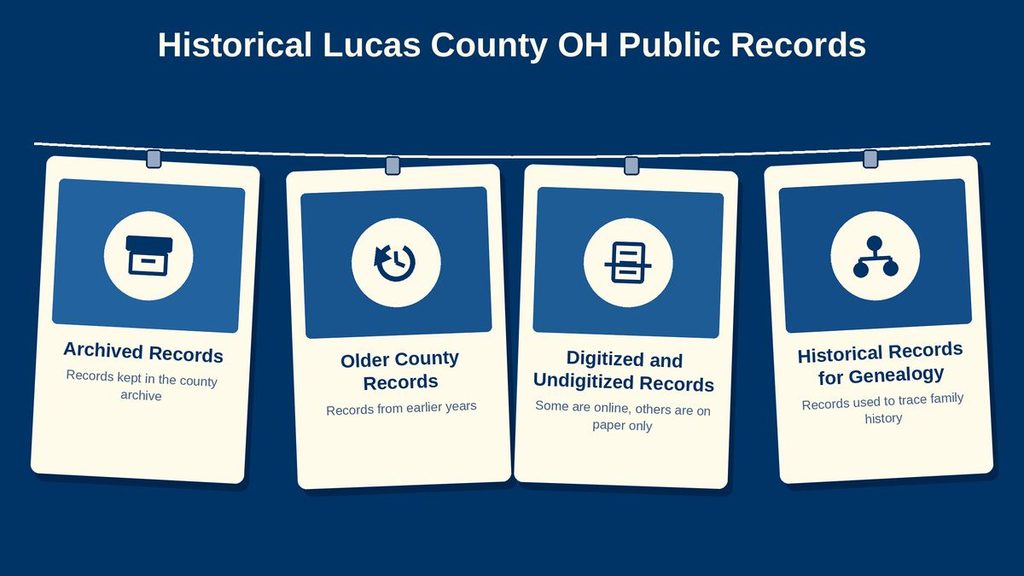
Archived Records
Archived holdings may be described through finding aids, collection lists, boxes, or bound volumes. A request should name the office or collection, approximate year, record type, and names involved. Archive staff can distinguish a record held in storage from a record that was never created or was destroyed under an approved schedule.
Older County Records
Names may use different spellings, married names, initials, or older legal styles. Municipal boundaries and township names also changed over time. Search by several name forms and by the location that existed when the event occurred. A date range with a reasonable margin can help locate a file whose index entry contains an imprecise year.
Digitized and Undigitized Records
A digitized record may be available as an image with searchable text or as an image without reliable text. Optical character recognition can miss handwriting, faded text, stamps, and old type. An undigitized record may exist only in paper, microfilm, or a bound book and may require staff retrieval, scanning, or a separate production charge.
Historical Records for Genealogy
Genealogical work often links birth, death, marriage, probate, land, and court records. Build the family timeline with exact dates, parents, spouses, and locations, then search each record type through the proper custodian. After locating a file, request a certified copy when the document will support a family claim, estate matter, or other formal use.
Public Record Accuracy and Updates
Most search results summarize index metadata rather than reproduce every document. Treat the index as a finding aid and use the filed document for the record’s actual contents. The office that keeps the file can explain whether an apparent difference comes from a late update, an index error, a changed case status, or a genuine conflict between records.
Record Accuracy
Names are commonly indexed as they appeared on a form or filing, which may differ from a current name. Dates can refer to the event, filing, recording, or certificate date. Read each date label before comparing it with another record. A name match alone does not prove that two files concern the same person.
Outdated Results and Data Entry Errors
Online indexes can lag behind recent filings. Tax balances change, property ownership can change, and court dockets receive later orders. A search result may also contain a misspelled name, transposed digits, wrong party, or poor scan. Compare several fields before treating a result as the correct record.
Correcting Record Information
Send the custodian the record number, the field that appears wrong, the exact correction requested, and supporting proof. The office decides whether the change qualifies as an index correction, an amended filing, or a new order. An index-only fix may not change the stored document, so ask which part of the record will be updated and whether the earlier version remains visible.
Certified Copies and Conflicting Records
A certified copy carries an official statement that the copy matches the record covered by the signer’s authority. It does not decide a disputed fact or guarantee the legal effect of a document. When a deed, court disposition, or vital record conflicts with another source, request the certified file and have the relevant legal or title professional review it.
Finding the Correct Public Record
An accurate result depends on three matches: the correct record type, the correct custodian or jurisdiction, and the right identifying details. The strongest identifier is usually a case number, parcel number, document number, or exact event date. Names work best when paired with a location or another identifier.
Identifying the Responsible Agency
Use the county’s official directory to locate the office that holds the file. Court cases belong to the clerk for the court; property data belongs to the Auditor, Recorder, or tax office; vital records belong to the local registrar or Ohio Department of Health; entity records belong to the Ohio Secretary of State. The Lucas County Clerk of Courts policy also states that requests should be directed to the county office that maintains the record.
Selecting the Correct Record Type
Match the request to the document that answers the question. A deed shows a recorded conveyance, while a tax screen shows assessment and payment data. A marriage license differs from a marriage certificate. A criminal case file differs from a complete criminal-history search, and a meeting agenda differs from the approved minutes.
Identifiers, Dates, and Locations
Use only identifiers that appear in the source or that the office confirms it can search. A combination of name, date, and jurisdiction often separates common names better than adding broad filters that could remove the correct file.
Distinguishing Similar Records
A law firm’s docket display may copy public court data, but it is not the official custodian. A private investigator’s file and a third-party background report are private products rather than government records. Court dockets also do not replace police incident reports, and a county tax record does not replace a deed. Use the relevant clerk, recorder, auditor, registrar, or state service for the official file.
Search Problems
Most failed searches result from the wrong jurisdiction, an unexpected name, an inaccurate date, or an index gap. Change one search factor at a time so you can see which change improves the results. If the file remains missing, make a formal request and describe what you searched so the custodian can check paper files or indexing records.
Search Problems and Solutions
Contact Details
Use the Clerk of Courts for records maintained by that office. Requests for files held by another county department should go directly to the responsible office, following the routing instructions in the official public-records policy. Each office may have its own request procedures, processing times, and applicable fees. Provide enough details to identify the requested document, such as a case number, filing date, or record type. Review the office’s instructions before submitting a request to avoid delays or misdirected inquiries.
Frequently Asked Questions
Public records give citizens direct access to official government documents. They help with background checks, property research, genealogy, and legal matters. Most records are free or low‑cost, and many counties offer online portals for quick retrieval. Knowing where to look and how to request files saves time and avoids unnecessary fees.
What types of public records can I find online in Lucas County?
Lucas County’s online portal lists court filings, property deeds, marriage licenses, birth and death certificates, probate files, and administrative orders. Each category links to the office that created the record. Start by selecting the record type, then follow the on‑screen prompts to view or request a copy. Most documents appear as PDFs that can be downloaded instantly.
How do I request a public records copy for a background check?
Identify the record’s holding office—often the Clerk of Courts or Sheriff’s Department. Submit a request form online or in person, citing the specific name and date range. Pay any required fee, usually under $20, then receive a certified copy by mail or email within five business days. Keep the receipt for future reference.
Where can journalists access public records for court cases?
Journalists should use the Lucas County public records portal and the state’s open‑records database. Both sites allow keyword searches by case number, party name, or filing date. For large data sets, request a bulk export through the clerk’s office. The portal also lists fee schedules and exemption guidelines for sensitive information.
What are the exemptions that limit public records access?
Exemptions include personal medical data, ongoing criminal investigations, trade secrets, and juvenile court files. When a request is denied, the agency must provide a written explanation referencing the specific law. If you believe the denial is incorrect, file an appeal with the county’s Records Access Board within ten days.
How can I use public records to research family history?
Start with birth, death, and marriage certificates available through the County Clerk’s office. Search probate files for wills or estate inventories that list relatives. Many older records have been digitized and can be accessed via the county’s digital archive or a genealogy‑focused API. Compile dates and locations, then cross‑check with census data for a fuller picture.