Criminal Records searches in Lucas County now tap the Ohio BCI’s official portal, letting users pull arrest logs, felony classifications, and misdemeanor details with a single query. By entering a name, case number, or date of birth, the criminal record database returns offense types, court dispositions, and sentencing information, helping residents verify public criminal records quickly and avoid mistaken identity mismatches.
Criminal Records inquiries also reveal whether a case is active, pending, closed, or acquitted, and clarify sealed or expunged statuses that hide juvenile entries. The system supplies certified copies for a modest fee, outlines processing times, and guides users on how to request missing or outdated entries, ensuring the public can trust the accuracy of Lucas County’s criminal case records.
How to Search Criminal Records
Criminal records for a Lucas County matter can involve an Ohio Bureau of Criminal Investigation report, a court case file, and a police record. A criminal record search helps a requester match a person to the correct case and review available charges including verified lucas county oh resources and outcomes, sentences, and case status An arrest entry by itself does not prove guilt. The BCI service covers the state; the court or agency holding a particular file controls that file’s details.
Official Search Portal: https://www.ohioattorneygeneral.gov/backgroundcheck
Steps to Search
- Open the official Ohio Attorney General background-check page and read the instructions for the criminal-history request that applies to your purpose.
- Follow the current request process and enter the person’s legal name, date of birth, and any other required identity details exactly as they appear on the request form.
- Complete the required payment and identity or fingerprint steps only when the selected request method calls for them.
- Review each entry for name, date of birth, court or agency, charge, case number, and disposition. Some fields may be absent depending on the source and record type.
- For a certified copy, a disputed entry, or a missing case, follow the instructions for the court or agency that holds the source record.
Lucas County Criminal Record Sources
A Lucas County criminal record lookup should begin by deciding which agency holds the requested record. One name can produce entries from several systems, and those records serve different purposes. A criminal-history report, a court docket, and a police incident file should not be treated as interchangeable documents.
Ohio BCI Role in a Lucas County Search
The BCI service is statewide, so one criminal-history request can bring together entries connected with more than one Ohio county. It is not a Lucas County-only docket and does not replace the clerk of court for the case under review. An entry in the BCI report may point to a court case, while the court file remains the source for the current docket, filed documents, full disposition, and sentencing terms.
A criminal record search by name and date of birth serves the BCI request process. A criminal record search by case number belongs with the court that issued that number. A Lucas County court case search by case number can prevent confusion when several people have similar names or when one person has more than one case.
The BCI report and a report prepared for a third party also have different uses. Federal consumer-report rules, including the Fair Credit Reporting Act, can govern an employer, landlord, licensing agency, or another organization that uses a criminal-history report for a covered purpose. A person checking personal records should follow the BCI request process, while an organization conducting a screen must follow its own legal duties and procedures.
Lucas County Court Role
Lucas County criminal cases are spread across more than one court system. The General Division of the Lucas County Common Pleas Court handles felony and serious misdemeanor cases. Municipal courts handle misdemeanor matters. The court’s clerk supplies docket entries and case documents for the court named in a report or search result.
A court docket may show a case number, case style, filing date, current status, and later docket events. It may not place every underlying document online. When a document is not available through the electronic docket, the requester can ask the clerk for the filed record. A court case status should be checked against the most recent docket event rather than an older BCI report.
Police Records and Court Records
An arrest record describes a police event. A criminal charge record reflects a prosecutor’s formal filing. A conviction record reflects a court finding of guilt. These records answer different questions, so an arrest should not be read as proof that a charge was filed or that a conviction occurred.
Some arrests end without a filed court case. Other cases begin with a complaint, then move through charging, plea, trial, sentencing, or dismissal. Police reports can also contain details that do not appear in a court docket, such as the narrative account of an incident. The jail booking or custody record is separate from the court’s final sentencing decision.
Offense Details and Case Status
Reading a criminal-history report requires attention to the distinction between an arrest, a charge, and a final court outcome. The fields below define the common terms used in criminal record information and help prevent a charge from being mistaken for a conviction.
Arrest Logs, Agencies, and Offense Types
Depending on the source, an arrest log can provide an arrest date, the agency involved, and a basic offense description. A criminal-history report may list the associated court, case number, charge, and later disposition. These fields help connect the police event with the court case, but they do not mean every arrest produces a filed charge.
The wording of an offense can change as a case moves forward. A police report may describe the suspected conduct, while the filed charge uses the legal charge created by the prosecutor. A court may later amend a charge or dismiss one count while allowing another count to proceed. Reviewing the charge and disposition together gives a clearer account than reading the arrest description alone.
Misdemeanor and Felony Classifications
Ohio classifies criminal offenses as misdemeanors or felonies, with different degrees within each classification. A record may show the classification, charge code, or degree. The classification states the type of alleged or proven offense; it does not state whether the person was convicted.
A case can contain several charges. One charge may be dismissed, another may be amended, and a remaining charge may lead to a plea or trial. The final docket can also show which counts were resolved under each plea. For that reason, a criminal charge record should be read as a collection of individual charges rather than as a single result for the whole case.
Court Dispositions, Sentences, and Fines
A case disposition records what the court decided. A dismissal ends a charge without a conviction. An acquittal is a not-guilty finding. A conviction records guilt after a guilty plea or trial verdict. Each result carries a different meaning and should appear as such in the criminal case records.
Sentencing details follow the disposition. Depending on the conviction and the law that applies, a sentence can include incarceration, probation, a fine, restitution, or other court-ordered terms. The court file is the source for the full sentence, payment amounts, and compliance events. A criminal-history report may provide a shorter record, so it should not replace the sentencing document when the complete terms matter.
Later court activity can add entries to the history. An appeal, post-conviction motion, sentence modification, or probation event may appear as a new docket entry. The date of each entry matters when reviewing a report for current standing.
Active, Pending, Closed, and Acquitted Cases
Active and pending both describe cases that have not reached a final end, although individual courts may use the labels differently. A closed case has reached a recorded conclusion. Closure can reflect a conviction, dismissal, acquittal, or another court action, so the disposition must be checked before drawing a conclusion from the status.
An acquittal is an outcome rather than a step in the case. A person found not guilty may still have a court record showing the charge and verdict. A criminal-history report can also carry a date that differs from the latest court docket because the two systems update their records separately. For the current status of a Lucas County case, the court docket and clerk’s office remain the controlling sources.
Public Record Availability and Official Copies
Public criminal records include several kinds of documents, and each source handles its own records under state law. Ohio Revised Code Chapter 149.43 governs public-record requests accessible through official criminal history records and subject to statutory exceptions and court orders An online search result, an ordinary printed copy, and a certified copy serve different needs.
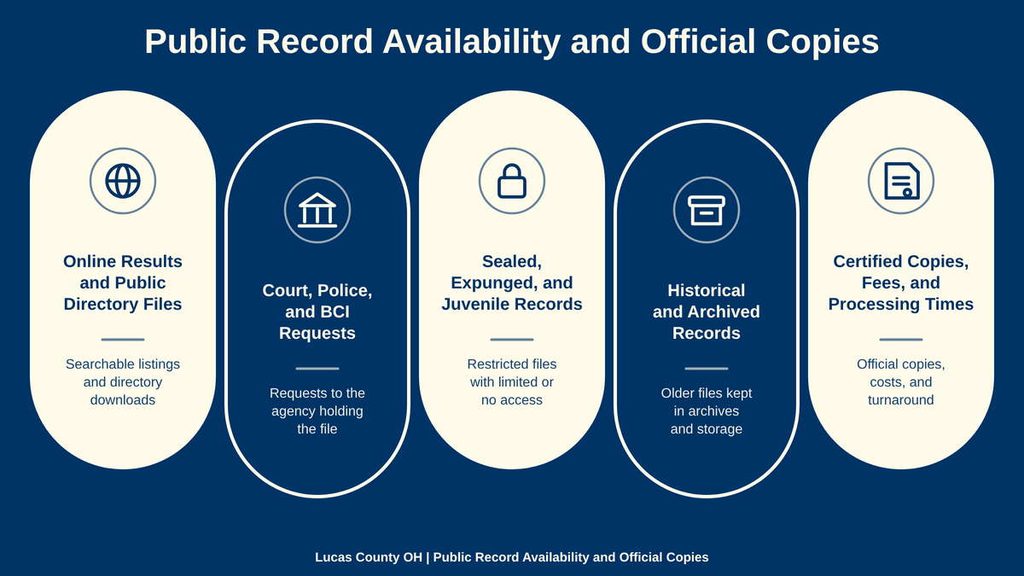
Online Results and Public Directory Files
When a court offers a public directory, it may list a case number, case style, filing date, and status without placing every filed document online. A requester may find the docket entry but still need to request the charging document, plea record, sentencing judgment, or another paper in the file.
Ohio’s public-records law provides a right to inspect and copy records unless an exception applies. The request should identify the agency, case number, record type, and person whose records are sought. The public office then responds within the time allowed by law for the type of request. An online index can save time, but it does not prove that every related record is available online.
Court, Police, and BCI Requests
The correct source depends on the document needed:
- The Lucas County Common Pleas court clerk holds case files for felony and serious misdemeanor matters handled by that court.
- A municipal court clerk holds the case file for a misdemeanor matter handled by that municipal court.
- A police agency holds arrest and incident records created by that agency.
- The Ohio BCI provides the statewide criminal-history request service and reports entries obtained through that process.
- A certified copy must come from the custodian of the source record, which may be the court, police agency, or another record-holding office.
Give the case number and issuing court whenever one is known. If the number is unavailable, provide the full legal name, date of birth, county, alleged offense, and approximate event date. A request sent to the wrong agency may be redirected, but it can create a longer wait while the record is located.
Sealed, Expunged, and Juvenile Records
A sealed record has been restricted by a court order. Sealing limits public availability; it does not erase the underlying court action. Expungement is a separate court process for records that meet Ohio eligibility rules. An expunged record may be withheld or reported with a notation, depending on the source and the terms of the order.
Juvenile records receive separate legal protection. Ohio public-records law excludes records of proceedings relating to the adjudication of juvenile cases from routine public inspection, subject to statutory exceptions. A juvenile matter can still exist even though it does not appear in an ordinary criminal-history search.
A missing entry does not prove that no arrest, charge, or case exists. The record may be sealed, expunged, protected as a juvenile matter, filed under a different name, or held outside the searched system. The court or agency holding the file can confirm whether an order affects public viewing.
Historical and Archived Records
Older criminal records may remain in a courthouse archive, clerk storage area, or law-enforcement archive rather than in a current online database. Historical case access can depend on record-retention schedules, file location, and the format in which the material was stored.
If a case predates the online index, a request for the archived file may require separate retrieval. An archived record should be checked for its closing date and any later sealing or expungement order. The age of the case does not by itself establish whether the record can be viewed by the public.
Certified Copies, Fees, and Processing Times
A certified copy is a copy that the record custodian states is true and correct to the records held by that office. A screen image, search result, or ordinary printout should not be called certified unless the issuing source states that it is. A BCI report should not be treated as a certified court file unless the BCI identifies it that way.
Copy charges for public records are limited by ORC 149.43(F), which addresses direct copying costs and permitted administrative charges. A BCI background-check service can have its own service fee and payment process. Check the current amount and payment instructions on the official request page before submitting an order.
Processing time depends on the request route, the check type, the availability of required fingerprints or identity documents, and the record being requested. The current estimate published for the selected method provides a better basis for planning than an old third-party article or an uncited processing claim. A certified copy request can also take longer when the file must be retrieved from an archive.
Record Accuracy and Resolution
A reliable criminal record verification uses an identity match, a source match, and a date match. The person’s identity must match the entry, the entry must come from the agency that holds the underlying record, and the result must be recent enough for the intended use. A name alone cannot complete all three checks.
Similar Name Matches
Same-name entries can involve different people, while one person may have several cases. Compare the legal name, date of birth, case number, court, charge, event date, and disposition whenever those fields appear. A middle name, suffix, or spelling difference may reflect how one agency recorded the same person.
Do not combine two entries merely because the names match. Keep each entry separate until a case number or another strong identifier confirms that both belong to the same person. Duplicate-looking entries can represent separate charges, separate courts, or an earlier name. A criminal record accuracy check should explain why two entries were treated as one or kept apart.
Multi-Jurisdiction and Update Differences
An Ohio BCI report can contain entries connected with several counties and courts. A Lucas County case may also involve a municipal court, another county, an out-of-state court, or a federal court. The statewide Ohio service should not be treated as a complete search of every court and record system in the United States.
Name formatting, address changes, aliases, amended charges, and court transfers can make separate records harder to match. A report date and a court docket date can also differ because the systems update at different times. For a local Lucas County case, compare the BCI entry with the issuing court’s docket. For records from another jurisdiction, use that jurisdiction’s official court or agency process.
Missing, Delayed, or Outdated Entries
A record missing from an online result can result from an identity mismatch, another name, a recent filing, a different jurisdiction, a data-update delay, or a legal restriction. The search should first be repeated with the exact legal name, date of birth, case number, and court. A name-only result that lacks the confirming fields should not be treated as a confirmed match.
If the court confirms a case that does not appear in the BCI report, gather the case number, filing date, date of birth, exact charge, disposition, and disposition date. Submit those details to the BCI with a request for correction review. BCI may request the identity proof or fingerprints required by its process before it can review a discrepancy.
A sound verification file contains the report used for the search, the matching court docket, and any certified source copy that matters for the purpose. It also records the date each document was obtained. Those steps create a clear record of what was checked and which office supplied each fact.
Contact Details
Use these details for questions about the statewide Ohio BCI background-check service. The Ohio Bureau of Criminal Investigation (BCI) handles fingerprint-based criminal background checks across the state. Visitors should review the current application requirements, identification rules, fees, and processing procedures before submitting a request. For accurate information, refer to the Ohio Attorney General’s official website and its published background-check instructions.
Frequently Asked Questions
Criminal records hold details about arrests, charges, convictions, and court outcomes. Accessing these files helps employers, landlords, and individuals verify background information, protect safety, and comply with legal requirements. In Lucas County, records can be found through the Ohio Attorney General’s Bureau of Criminal Investigation, local courts, and police agencies. Knowing where to look and how to request copies saves time and avoids unnecessary fees.
How can I search Lucas County criminal records by name?
Visit the Ohio Attorney General’s background‑check portal and enter the full name, middle initial, and date of birth. The system cross‑checks the name against the state’s criminal‑history database and returns any matching court or arrest files. If results appear, note the case number and contact the Lucas County clerk’s office for the official record copy. This method offers the quickest online route.
What steps are required to request a certified criminal record from Lucas County?
First, gather a government‑issued photo ID and the person’s full legal name. Then, complete the request form on the Lucas County Court website or submit a written request to the clerk’s office. Pay the statutory fee, usually via credit card or money order. The clerk processes the request within 10‑14 business days and mails a certified copy to the address on file.
Can I look up Lucas County criminal case status using a case number?
Yes. Enter the case number in the online case search tool on the Lucas County Courts’ portal. The page displays the current disposition, upcoming hearing dates, and any sentencing information. If the case is sealed or expunged, the system will hide details, and you must contact the court directly for verification.
Why might a criminal record search return no results for a known arrest?
Several reasons exist. The arrest could be older than the database’s retention period, or the record may have been sealed, expunged, or transferred to a different jurisdiction. Additionally, misspelled names or incorrect birth dates prevent matches. Double‑check spelling, try alternative name formats, and verify the correct county before contacting the Ohio Bureau of Criminal Investigation for assistance.
What are the fees and processing times for public criminal records in Lucas County?
Fees range from $5 for a basic arrest summary to $25 for a full certified record. Expedited service adds $10 and reduces processing to three business days. Standard requests take 10‑14 days. Payment must accompany the request; otherwise, the clerk returns the form for completion. Keep receipts for any future background‑check verification.