
Death Records are often the first clue families need when tracking a loved one’s final paperwork. A quick death records lookup can reveal how to order a certified death certificate, typical fees, and the turnaround time for each state office. By entering the decedent’s name or registration number in a death record search, you can confirm the cause of death, see the official vital statistics, and download a printable copy for legal use.
Death Records access is limited to eligible requesters, such as immediate family or legal representatives, to protect privacy under state statutes. When you submit a death certificate request, you’ll need a government‑issued ID and may be asked for supporting documents that verify your relationship to the decedent. Fees vary by jurisdiction, and many offices now accept online payments, making the death record application faster while still safeguarding sealed medical details.
How to Search Death Records
Death records are official registration records for people who died in Lucas County, Ohio. A death records lookup can locate a filed record accessible through official death index records and confirm whether a certificate exists, and show which request process applies The Toledo-Lucas County Health Department provides the local starting point for death certificate service. State rules govern certified copies, requester eligibility, corrections, and older records.
Official Search Portal: https://lucascountyhealth.com/vital-records/death-certificates/
Steps to Search
- Open the Lucas County death certificate page and review the current service instructions and linked order route.
- Choose the death certificate or certified-copy service named by the agency. A private genealogy search result is not an agency record.
- Enter the decedent’s legal name and any confirmed date or place of death. Add a registration number only when it came from an official source.
- Compare each match using date of birth, date and place of death, parents’ names, and residence. Keep competing matches open until one official record matches.
- Follow the posted eligibility, identification, fee, and delivery instructions for certified copies. Use the county office’s contact details when a match remains unclear.
Death Record Details and Causes of Death
A useful death record search does more than match a surname. The registration entry connects a person’s legal identity with the death event, medical certification, funeral disposition, and registration history. Reading those parts together helps prevent a false match and shows which details can support a certified-copy request.
Decedent Identity and Registration Number
Start with the name as it appears on the source record. A full legal name is more useful than a nickname, and a name-only result should be checked against other facts. The same person may appear on a birth record, a death index, and a certificate with slightly different spelling or formatting.
A registration number gives the cleanest match. If that number is unavailable, do not create one from a sequence found in a genealogy index. Use the agency’s search instructions or ask the local office which identifier applies to the record being sought.
Immediate Family and Eligible Requesters
Ohio does not treat every recent death certificate as an unrestricted public document. Certified copies are supplied to recognized family members, qualifying legal representatives, authorized professionals, and agencies performing official duties. Recognized family relationships can include a spouse, parent, child, sibling, or grandparent. Qualifying legal roles can include an executor, administrator, guardian, or attorney-in-fact.
The requester must select a valid category on the official form and support that claim when requested. A family request may call for proof of relationship, while a legal representative may need probate, guardianship, or other papers showing authority to act. A person asking on behalf of a relative should prepare both identification and the document connected to the claimed relationship.
Cause, Manner, and Medical Certification
The cause of death states the disease, injury, or condition sequence that led to death. A certificate may show an immediate cause, conditions leading to it, an underlying cause, and other significant conditions. Each line helps explain the medical sequence; a condition listed for context is not automatically a separate cause.
The manner of death places the death in a category such as natural, accident, suicide, homicide, undetermined, or pending. A physician, medical examiner, or other authorized certifier completes the medical certification as required by Ohio law. The wording gives the official classification rather than access to the person’s private medical file.
A pending cause does not always mean the registration is missing. Some deaths await medical review before the cause can be completed, and a later amendment may replace the pending entry. The medical examiner’s case file, autopsy report, and laboratory results remain separate from the death certificate. Each source has its own custodian and release rules.
Official Certificates, Request Documents, and Fees
A search result can identify a record, but it does not replace a certified death certificate when a probate court, insurer, pension agency, employer, court, or government program asks for official proof. A certified copy comes through the approved process operated by the Ohio Department of Health system or an authorized local registration office. The Lucas County office can direct a requester to the proper issuance route.
A printout from a government website is not certified merely because the page belongs to a public agency. Certification comes only through the issuing office’s approved process.
Identification and Supporting Documents
Have the requester’s government-issued identification ready before starting an application. The name and address shown on the identification should match the application unless the requester can explain the difference through documents accepted on the official form. A family request may also call for evidence of the claimed relationship.
A person acting for a deceased relative should prepare the legal document that grants authority. The accepted document can depend on the role, such as executor, administrator, guardian, or attorney-in-fact. Sending a photocopy does not change its status; a photocopy of a certified certificate remains uncertified unless the office states otherwise.
Fees and Processing Time
The fee can depend on the copy type, the number of copies, and the ordering route shown by the agency. Use the current amount on the Lucas County page or its official state order service. Older posts, private vendors, and search-result snippets may quote outdated prices, so the amount presented by the agency should control.
Check the stated processing period at the same time as the fee. A death awaiting medical review can take longer to complete than a record without that review. Submitting an online request does not mean a certified file is ready at once; the certificate must be produced through the office’s stated delivery process.
Keep the receipt or confirmation number with the request. If the confirmation names a file number, use that number in later calls or messages rather than relying on a partial name match. Payment alone does not create a certified copy, and a search listing does not show whether the certificate has entered production.
Public Availability and Confidentiality in Ohio
Ohio rules control requests connected with an Ohio death. Rules from another state do not apply merely because the person lived there, and a private database cannot decide what the state will release. This distinction affects requester eligibility, certified-copy fees, processing time, and historical access.
Death Records More Than 25 Years Old
Ohio makes death records more than 25 years old available for public request. That threshold changes who may ask for a certified copy; it does not turn an old index listing into a certified certificate. Older files may also sit in an archive rather than the current online ordering system.
For historical research, a requester can begin with the person’s name and known event details, then ask the agency how the archived record is handled. If a family event occurred before statewide registration, the agency may need a different archive or source. Early records may not contain the same fields found on a modern certificate.
Restricted Recent Records and Sealed Details
A death within the most recent 25 years remains subject to Ohio’s eligibility rules even if an online index shows the name, date, or county. The index is a locator. It may omit medical certification, and its presence does not grant permission to obtain a full certified copy.
Medical cause details can carry privacy protections, particularly for a recent record or a death connected with a medical examiner case. The public-facing index and the certified certificate serve different purposes. Requesting a certificate does not open the medical examiner file, autopsy report, hospital chart, toxicology report, or police file. Each source has its own custodian and release rules.
What Public Search Results Can Show
A public index may show a decedent’s name, date of death, county, registration year, and a locator for the full file. Some indexes omit parents accessible through official obituary online registry databases and residence, cause, manner, or the medical certifier The fields shown can vary with the age of the record and the system that created the index.
Use an index to narrow the search, then confirm the matched identity through the issuing agency. A private collection can help identify spelling variants, but its dates and family relationships may contain errors. The official registration file should control when a certified copy is needed.
Correcting Errors and Amending a Death Record
A death record may contain a spelling mistake, wrong date, missing place, incorrect parent or spouse name, or unfinished cause. Some errors come from the source documents. Others occur when data is transferred into the registration system. The correction route depends on the field, the source of the error, and the evidence available.
Identify the Error Before Requesting a Change
Compare a new certificate with the documents that support the claimed value. A hospital record, funeral-home document, physician certification, medical examiner report, or court record may provide evidence. Family recollection can point to a problem, but it cannot replace the official evidence required by the correction process.
Correction Paths for Errors
Never erase, mark up, or alter a certified copy. A damaged or altered copy may be rejected by the agency receiving it. The issuing office must approve the correction and produce any replacement. Keep copies of every submitted document and the agency’s written decision. If a correction is denied, ask for the reason and which additional evidence or legal step is needed. This record can prevent the same question from being raised during a later certificate request.
Amending a Pending Cause of Death
A cause marked pending may be completed after medical review. If the disease or injury sequence changes, the authorized certifier supplies the amended medical certification. The vital records office then updates the registration file and can issue a replacement certified copy once the amendment is recorded.
Resolve Missing, Delayed, or Unlisted Death Records
A search that returns no match can reflect a name issue, a recent filing, a record held in another jurisdiction, or delayed medical certification. The right next step depends on which condition applies. Repeated broad searches with guessed data can create another false match instead of resolving the file.
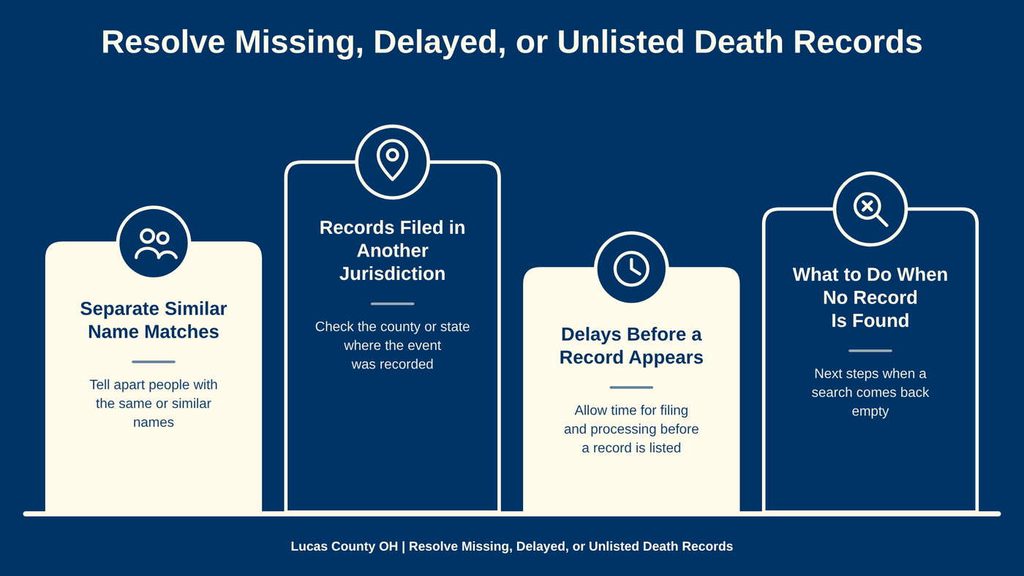
Separate Similar Name Matches
Compare each candidate across several fields, not just the name. Date of birth, sex, parents’ names, date and place of death, and residence can expose a mismatch. If two records remain close, ask the office to compare registration numbers, local file details, and source documents.
Records Filed in Another Jurisdiction
The place where the death occurred usually controls which local registrar first receives the registration. A person who lived in Lucas County may have died elsewhere, leaving the record with another county or state. A residence address cannot replace the place of death when locating the filing office.
Delays Before a Record Appears
Registration can wait on a signed certificate, the funeral-home section, medical review, or correction of the reported place or identity. A death with a pending cause may have a registration record without a final cause. The registration date and medical status can explain why a current portal does not show the expected file.
What to Do When No Record Is Found
- Search the full legal name using each confirmed spelling. Remove titles, suffixes, and punctuation that the form does not require.
- Add one reliable filter at a time, such as year of death, county, or place of death.
- Try a known registration or file number without adding other uncertain text.
- Contact the vital records office for the place of death and state the decedent’s full name, date of death, and address.
- Allow for a pending registration, then ask the office whether a later check is needed.
If the death occurred more than 25 years ago, ask about Ohio’s historical request process. For a very old event, the agency can direct the requester to the archive or source that holds the earliest record. A separate cemetery, church, or funeral-home record may help locate the event, but it does not replace the state’s death registration.
Death Records and Related Record Types
Several online collections look similar because each contains a person’s name and dates. They answer different questions, and only the registered death record serves as the official registration of the death event.
A cemetery date may differ from the registered date of death. An obituary may use a remembered date, and a genealogy index may misspell a name. Check each fact against the registration record rather than combining fields from separate sources.
Contact Details
Use these details for questions about local death certificate services, missing Lucas County results, or correction requests. Contact the appropriate office to confirm record availability, eligibility requirements, and applicable fees. Provide relevant dates and identifying details when making an inquiry. For certified copies or official corrections, follow the instructions issued by the responsible records office.
Frequently Asked Questions
Death records help families prove identity, settle estates, and access benefits. The Toledo‑Lucas County Health Department keeps official copies, while online portals speed up searches. Knowing how to request, verify, or correct a death certificate saves time and avoids extra fees.
How can I search for a death record in Lucas County, Ohio?
Start at the Toledo‑Lucas County Health Department website. Enter the decedent’s full name, date of death, and, if known, the record number. The portal returns a match, shows whether a certified copy is available, and lists required identification. If the online search fails, call 419‑213‑4100 during business hours for assistance.
What documents are needed to request a certified death certificate?
Bring a government‑issued photo ID, proof of relationship or legal interest, and the decedent’s full name and date of death. Complete the application form available online or at 635 N. Erie Street. Fees range from $10 to $15 per copy, payable by cash, check, or credit card.
Can I obtain a death record online without visiting the office?
Yes. The health department’s online portal lets you request a certified copy after uploading a scanned ID. After payment, the certificate is mailed within 7‑10 business days. For urgent needs, select the express service for a 3‑day turnaround, which adds a small surcharge.
How do I correct incorrect information on a death certificate?
Contact the Vital Records Office with the original certificate, a written request, and supporting evidence such as a hospital record or police report. The office reviews the request, updates the record, and issues a corrected copy. Expect a 10‑day processing period and a $5 correction fee.
What are the eligibility rules for public death records?
Immediate family members, legal representatives, and persons with a documented need (e.g., insurance claims) may request copies. Researchers can view older records—typically those older than 50 years—through the county archive or state database. Restricted records, like recent deaths, require proof of relationship or a court order.