
Arrest Records reveal who was taken into custody, when, and which agency filed the report. A quick public lookup by name or date lets you see subject details, charges, and booking photos without endless forms. Users often need misdemeanor or felony classifications, facility location, and warrant status. Our guide aligns search results with legal presumption of innocence, so you can interpret the data confidently.
An arrest record search by name or agency pulls data from the online law enforcement arrest records database, showing arrest history, case numbers, and any associated court filings. You can also filter by county to find public arrest records in Lucas County or neighboring jurisdictions. The system flags expunged or sealed files, clarifies missing entries, and highlights whether booking photos are attached, helping you verify identity and understand the circumstances.
How to Search Arrest Records
An arrest record is a law-enforcement record created when a person is taken into custody. An online law enforcement arrest records lookup can connect a name with an arrest date including verified lucas county oh resources and reporting agency, booking number, charge, custody location, and related court case The purpose is to identify the correct record, not to decide whether the person committed the alleged act. A listed charge is an accusation, and the court disposition must be read before the record is used for any decision.
Official Search Portal: https://lucascountysheriff.org/about/department
Steps to Search
- Open the official Lucas County Sheriff’s Office page above. Follow any records-request or public-directory link shown in its site navigation.
- Choose the closest arrest-record category or request option. Enter the person’s full legal name, including a middle name or suffix when known.
- Add the most exact detail available: arrest date, case or report number, arresting agency, or county. Each detail can reduce a long list of possible matches.
- Review each match for name, date, agency, custody location, and case number. Check that the known details point to the same person and event.
- If no match appears, use the department’s current request process with the same facts. Ask whether the record is absent, not yet posted, sealed, expunged, juvenile, or held by another agency.
Search Fields That Help Narrow an Arrest Record Match
An arrest records search by name can return people with similar names. The most reliable match comes from comparing more than one field rather than relying on the name alone. Prepare the following details before searching or sending a request.
Use details that you know and can lawfully share. If a search produces many matches, start with the full name and then compare dates, agencies, and numbers. A mismatch on one field may reflect a spelling variation, a different date label, or a record held by another office rather than a false arrest record.
Record Information and Charges
An arrest file contains parts with different purposes. The law-enforcement portion describes the reported arrest and booking, while a court filing tracks formal charges, motions, evidence, and the final case status. Reading both parts gives the clearest picture of what happened and how the case ended.
Subject Details, Date, and Agency
Subject fields may contain a person’s full name, birth date, physical description, address, or other identifying details, depending on the source. A record can use a middle initial, a different spelling, or an alias. These differences matter because the same person may appear under slightly different labels in a booking entry, report, and court case.
Keep each date labeled by its source. The arrest date marks the reported custody event, the booking date identifies processing at the facility, and the court filing date belongs to the legal case. A report date may mark when the report was prepared. Combining these dates into one can place the same event in the wrong search period.
Misdemeanor and Felony Charges
Misdemeanor and felony are legal classifications. The exact charge and the law applied by the court determine the classification, so labels from unrelated websites should not replace the charge listed in the official record. A person may face several charges arising from the same arrest, and one charge may be dismissed or amended during the case.
Charge wording in an arrest report can differ from the formal wording in a court filing. A report describes the basis for the arrest, while a charging document states the claims filed by the court. A charge appearing in an arrest entry is an accusation unless a later court disposition shows that the person was convicted.
Arrest Circumstances and Reports
If an arrest report is released, it may state the circumstances that led to the arrest, the alleged offense, the reporting agency, and the location of the arrest. It may also contain a report number, narrative, property details, or a reference to a warrant. The exact contents depend on the agency and the status of the case.
An arrest report search and a court record search answer different questions. The report explains the law-enforcement event, while the court record shows charges, rulings, plea decisions, trial outcomes, or dismissals. A charge can exist without a completed conviction, and an arrest can have a related court case that ends without a conviction.
Custody and Associated Judicial Records
Custody details describe where and when the agency held a person after arrest. Judicial records describe the case created by the arrest. The booking facility, arresting agency, and court may all be different entities, so each record should be matched through names, dates, report numbers, and case numbers.
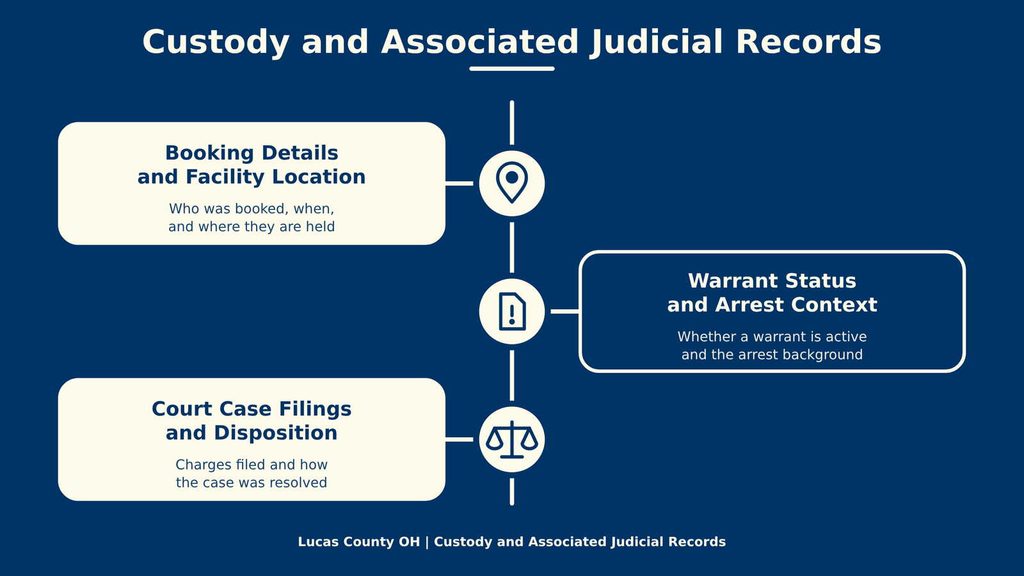
Booking Details and Facility Location
Booking details commonly include a booking number, date and time, facility, and custody status. The facility named in the entry is the location of the booking, not necessarily the place where the arrest occurred. A person may be arrested in one city, transported to a county jail, and later appear before a court in another jurisdiction.
Custody status can change after an online entry is created. Release, transfer, court supervision, rearrest, or a change in legal status may alter the entry. Treat a public listing as a dated snapshot. Its status is most useful when paired with a booking date and checked against a later court record.
Warrant Status and Arrest Context
A warrant entry may describe an active warrant, a warrant used during the arrest, a cleared warrant, or a recalled warrant. The wording depends on the agency. Compare the issuing authority, warrant number, and date because a status copied from an older page may no longer describe the person’s legal situation.
A missing warrant field does not prove that no warrant existed. Some entries omit warrant data, and some records contain only the arrest result. If warrant status affects your decision, request the current status from the agency or court named in the record rather than drawing a conclusion from a blank field.
Court Case Filings and Disposition
An arrest may lead to a court case with its own case number, filing date, charges, and procedural history. The court named in the filing controls the case status. A case filing can show a dismissal, acquittal, conviction, or another ruling, but the entry should be read in full because later filings often explain what changed.
A dismissal and an acquittal have different legal meanings. A dismissal ends the case without a conviction under the stated ruling. An acquittal means the court found the prosecution had not proved guilt. A conviction records a legal finding after the court process, subject to any later appeal or other legal action.
Use these fields to connect the arrest record with the court history:
- Full name and any name used during booking
- Arrest, booking, report, and court filing dates
- Arresting agency, booking facility, and court
- Arrest or report number and court case number
- Charge wording and misdemeanor or felony classification
- Custody or warrant status with its recorded date
- Court filings, plea, dismissal, acquittal, or conviction status
- Booking-photo status and the date of the latest displayed entry
Photographs and Public Records
Photographs can help connect a person with a booking entry, but they are only one matching detail. Public directories vary in the amount of data they show accessible through official sex offenders records and and some records contain redacted fields or no photograph The best identity check uses several facts rather than a face alone.
Booking Photos and Identity Verification
A booking photograph is an image taken during the booking process, not a current identification photo. The person’s appearance may have changed, and the image may come from a different date than the court proceeding. Image quality, camera angle, and the length of time in custody can also affect how the picture appears.
Compare a booking photo with the name, birth date, arrest date, agency, booking number, and case number found in the same entry. A photograph on a public page can confirm that an image was linked to a record, but it cannot prove that the pictured person committed the alleged act. Extra caution is needed when a name is common and several photos appear.
Public Directories and File Redactions
A public arrest directory may show a booking photo, name, arrest date, agency, booking location, charge, and case number. It may not reproduce the full report, court ruling, or investigative file. The directory row is a finding aid that helps direct a request to the agency holding the underlying record.
A redacted field has been withheld or limited for a legal or policy reason. It does not mean the field was false, and a blank value does not prove that the underlying event did not occur. A visible booking photo does not make every report, witness statement, juvenile file, or sealed court document part of the same public record.
Juvenile and Active File Restrictions
Ohio applies special confidentiality protections to juvenile records. The rule depends on the type of record, the person’s age when the event occurred, and the purpose of the request. A name appearing in a general arrest list does not remove those protections or grant permission to publish juvenile details.
Some law-enforcement reports remain unavailable while investigative work is active. A court filing may become part of a public court record at a different time from the police report. File status should therefore be checked with the agency or court that holds it, and a request should state why the record is needed.
Record Accuracy and Resolution
An arrest record search can produce a correct name match with missing dates, stale status, or fields from different stages of a case. Accuracy checks matter because law-enforcement data, jail rosters, and court systems may update at different times. A careful search keeps each source, date, and identifier tied to the entry where it appeared.
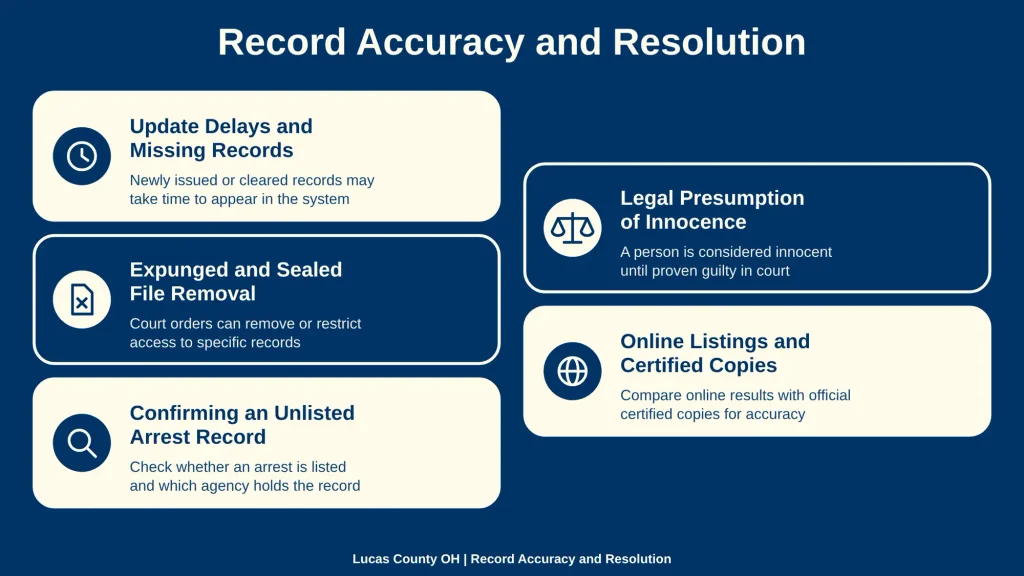
Update Delays and Missing Records
Do not treat an online entry as live status unless the source expressly states that it is live. A row may reflect a booking feed, a jail roster, a report index, or another agency source. Court events can occur after the law-enforcement entry, so a recent arrest may have a newer case status elsewhere.
Several common factors can explain a missing result:
- The name appears under a different spelling, middle initial, suffix, or alias.
- The arrest was handled by another agency or booked outside the requested county.
- The matter appears in a court filing but not in a law-enforcement directory.
- The entry had not been posted at the time of the search.
- Juvenile, sealed, expunged, or active-file rules block ordinary viewing.
- The source uses the arrest date, while the request used a booking or filing date.
- The record is stored under an agency report number rather than the court case number.
An empty search result is not proof that no arrest occurred. It means that the requested source did not return a matching public entry. A records request with known identifiers can confirm whether the file exists, where it is held, and whether its status limits public viewing.
Expunged and Sealed File Removal
In Ohio, expungement is a court-ordered process that seals a qualifying record and limits ordinary public viewing. It does not necessarily mean that every paper copy was physically destroyed. A court file may remain under restricted handling after its details disappear from an online index.
A sealed record is restricted by a court order, but not every sealed file has been formally expunged. The reason for sealing and the record’s legal status can differ. An online system may keep a case number, status label, or generic notice after removing the restricted details.
Ask the current record holder to confirm the status rather than trying to work around a hidden entry. If an expungement or sealing order may exist, provide the case number and known identifiers so the agency or court can locate the order. Avoid republishing restricted details or photographs.
Confirming an Unlisted Arrest Record
Prepare a clear set of facts before requesting confirmation: full legal name, known aliases, date or date range, arresting agency, county, case or report number, and any booking details you know. If you have a court case number, include it because it may link the arrest event to the legal case.
Send an arrest-report or booking question to the agency that made the arrest. Send a charge, plea, or disposition question to the court named in the case filing. If the Lucas County Sheriff’s Office did not make the arrest, the request may need to go to the police department, municipal agency, or other custodian involved.
Ask for the record’s present status, including whether it was never posted, is filed under another spelling, belongs to another agency, remains sealed, has been expunged, or is subject to juvenile or active-file restrictions. Keep the agency’s written answer with your search notes.
Legal Presumption of Innocence
The legal presumption of innocence means that an arrest or charge does not establish guilt. A person listed in an arrest record has not been found guilty merely because the entry appears online. A conviction is a court finding, and the full case history is needed to explain what the court decided.
Use careful wording. “Listed as arrested,” “charged with,” and “the court recorded a conviction” describe different stages. Avoid stating that a person committed an alleged act unless an official source confirms the legal outcome. If an entry is expunged, sealed, or still active, keep those limits clear when sharing the record.
A booking photo can be linked to an arrest without proving the allegation. The same rule applies to a report narrative, a police classification, and a warrant listing. Court status should be checked as close as possible to the date of the decision or the date on which the record will be used.
Online Listings and Certified Copies
An online directory entry is not the same as a full arrest report or a certified court copy. The directory helps identify a person, event, agency, and number. A requested report may contain the official narrative, while a certified court copy serves a separate legal or administrative purpose.
If a legal, licensing, employment, insurance, or immigration process asks for a certified copy, request that copy from the custodian responsible for the record. Ask for the current copy type, fee, delivery method, and processing time directly. Do not rely on an unverified fee, turnaround claim, or statement that a public directory contains every document in the case.
Contact Details
Use the contact details below for questions about Lucas County arrest records, booking details, or a records request. The non-emergency line is for deputy response needs and is separate from the main office number.
Frequently Asked Questions
Arrest records give a clear view of an individual’s contact with law enforcement. Accessing these files helps verify identity, settle disputes, and protect personal safety. Online lookup tools connect a name to dates, agencies, charges, and case numbers, making the search fast and reliable.
How can I search arrest records by name?
Enter the full or partial name into a reputable arrest record search site. Choose the state or county, then click search. Results list each match with booking date, agency, charge, and case number. Review the court disposition to see if the charge led to a conviction.
Where do I find public arrest records online for Lucas County, Ohio?
Visit the Lucas County Sheriff’s Office website or use the state’s public access portal. Input the person’s name or case number. The system returns the arrest date, booking number, arresting agency, and current custody location. For further details, call the non‑emergency line at 419‑255‑8443.
Can I look up arrest records by date or location?
Yes. Select the date range field and enter the start and end dates. Add the city or county in the location field. The query returns every arrest that matches the criteria, showing charge, agency, and case status. This method helps track incidents in a specific area.
What does an arrest record tell me about the outcome of a case?
The record lists the original charge and the court disposition. A disposition marked guilty, not guilty, or dismissed indicates the final result. Always read the disposition field before assuming guilt, as many arrests end without a conviction.
How do I verify the accuracy of an arrest history report?
Cross‑check the report with the official court docket or the agency that made the arrest. Call the Lucas County Sheriff’s Office at 419‑213‑4900 to confirm booking numbers and dates. If discrepancies appear, request a correction through the appropriate court clerk.