
Court Calendar tools let citizens pinpoint hearing time, courtroom location, and presiding judge without endless scrolling, turning a confusing docket into a clear schedule. By entering a case number or party name, the search returns the hearing calendar, court date lookup, and upcoming court dates alongside status codes that flag continuances or sealed sessions. Users can instantly see whether a motion, trial, or sentencing appears on the court schedule, reducing missed appearances and saving time.
Court Calendar information is refreshed daily, so a quick court calendar search reveals the latest court docket entries, hearing schedule by case number, and any virtual hearing links. The interface also supports court calendar by judge and court schedule lookup, helping attorneys verify rescheduled court dates or in‑person attendance rules. For Lucas County residents, the official online docket page offers real‑time access to trial division listings and contact details for further assistance.
How to Search Court Calendar
A court calendar links a case to scheduled court events. A Lucas County docket search can show the listed hearing date, time, courtroom, event type, judge, status, and any remote-hearing link for General Trial Division matters. The county directs users to Justice Case Access referencing verified court docket online search records and and research OH through its Online Dockets page Use the case-specific docket to confirm a planned appearance rather than relying on an old date, printed notice, or third-party entry.
Official Search Portal: https://www.lucascountyoh.gov/3707/Online-Dockets
Steps to Search
- Open the Lucas County Online Dockets page and review the docket services named there.
- Choose a listed service, then follow its prompts for the proper court category.
- Enter the full case number when available. If using a party name, enter the name shown on the case and expect to check several possible matches.
- Open the matching result and compare the case number, listed party names, and case type before reviewing a hearing entry.
- Check the newest calendar entry for its date, time, courtroom, hearing type, judge, status marker, and remote-hearing link.
Find a Court Calendar by Case Number, Name, Judge, or Date
The best search method depends on what the reader already knows about the case. A case number gives the most direct route to one docket, while a party name, judge, or date can produce a broader set of results. Each method requires a final check against the case-specific docket.
A name, judge, or date search can return several matters. Narrow the results with the case number or the exact hearing date. If two entries carry different dates or times, treat the conflict as unresolved until the newest docket entry and the Clerk of Courts confirm the correct listing.
Court Schedule Information
General Trial Division case records are available through the services listed on Lucas County’s Online Dockets page. One case can contain several calendar entries, including motions, pretrial conferences, trials, or sentencing hearings. Read the newest event and its surrounding history instead of judging the case from a single line.
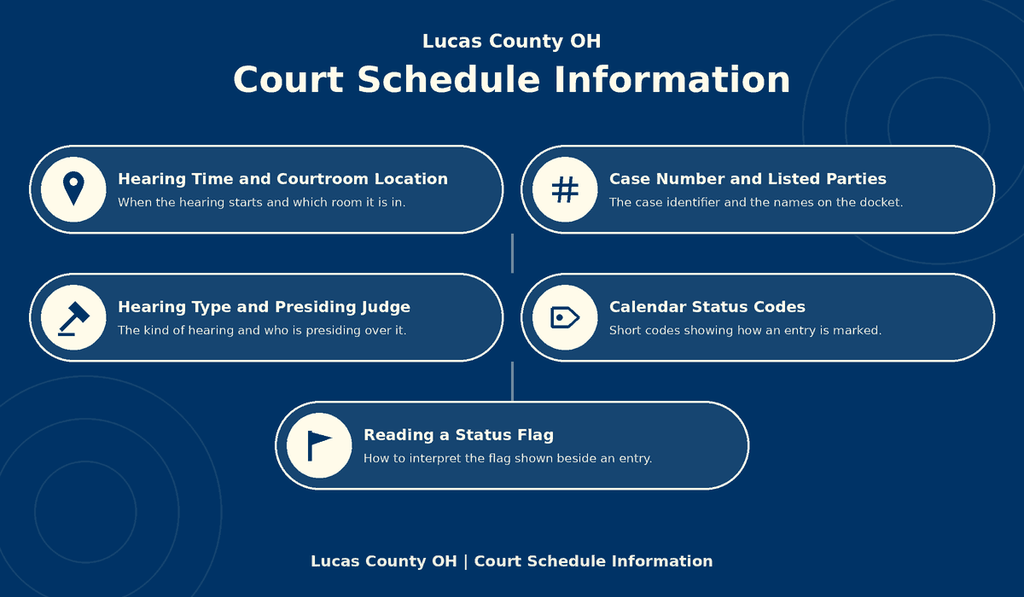
Hearing Time and Courtroom Location
The hearing date tells the reader when an event is listed. The time and courtroom show when and where the appearance may take place. A courtroom assignment can change after an event is posted, so check the newest entry and any related notice before traveling. If the time or courtroom is blank, treat that field as missing rather than guessing a default time or room.
Case Number and Listed Parties
The case number is the strongest matching field when one record is needed. A party-name search can return cases with similar names, so compare the full case number and listed parties before opening a hearing entry. Sealed records may show less detail, which can make a name search harder to interpret. Do not treat a missing name as proof that no matching case exists.
Hearing Type and Presiding Judge
The hearing type explains why an event appears on the schedule. The judge field shows the judge listed for that event, which can help the reader confirm the correct courtroom or calendar. A continuance may pair a new date with a different judge, so the judge and date should be checked together. The hearing label and judge identify the listed event without deciding what will happen at the hearing.
Calendar Status Codes
Status codes can flag a continuance or a sealed session. Exact wording may differ between docket services, so read the service’s on-screen legend and the complete event line. A short code by itself may not show the replacement date, the reason for a change, or the level of detail withheld from public view.
Reading a Status Flag
Status clues provide context for the date and details shown beside them. A current hearing plan should rest on the full case history, not on an isolated code. If the visible events do not agree, keep checking for a later entry and verify the conflict with the Clerk of Courts.
Types of Court Hearings
Hearing labels describe the purpose of a scheduled event. The same case may have several types of events across its court history. A label identifies what the court set on the calendar; it does not reveal the result, settlement terms, or full details of the matter.
Civil, Criminal and Family Dockets
General Trial Division can cover civil and criminal matters. Civil cases often involve disputes between private parties, while criminal cases involve prosecution by the government. Family cases may be assigned to another court division, so confirm the court named on the case before using a General Trial Division result. A family-related party name in a search result does not prove that every related case belongs to the same division.
Arraignments and Pretrial Hearings
An arraignment is a criminal hearing at which the defendant enters a plea to the charge. A pretrial hearing gives the court and parties time to address case issues, possible motions, and trial preparation. These labels identify the stage of the case, not whether a plea was entered or every issue was settled. The docket event confirms that the hearing was listed for review.
Motions, Trials and Sentencings
A motion hearing concerns a request for a court order. A trial is a scheduled hearing where evidence is presented. A sentencing hearing follows a criminal conviction and concerns the penalty imposed by the court. Exact docket labels can vary, so read the full event title, date, status, and related case entries before drawing a conclusion about the hearing.
What a Court Calendar Confirms
A docket calendar answers a focused question: what court event is listed for a case? It does not provide the full story of the case. Reading each entry in context helps prevent an upcoming hearing from being mistaken for a final result.
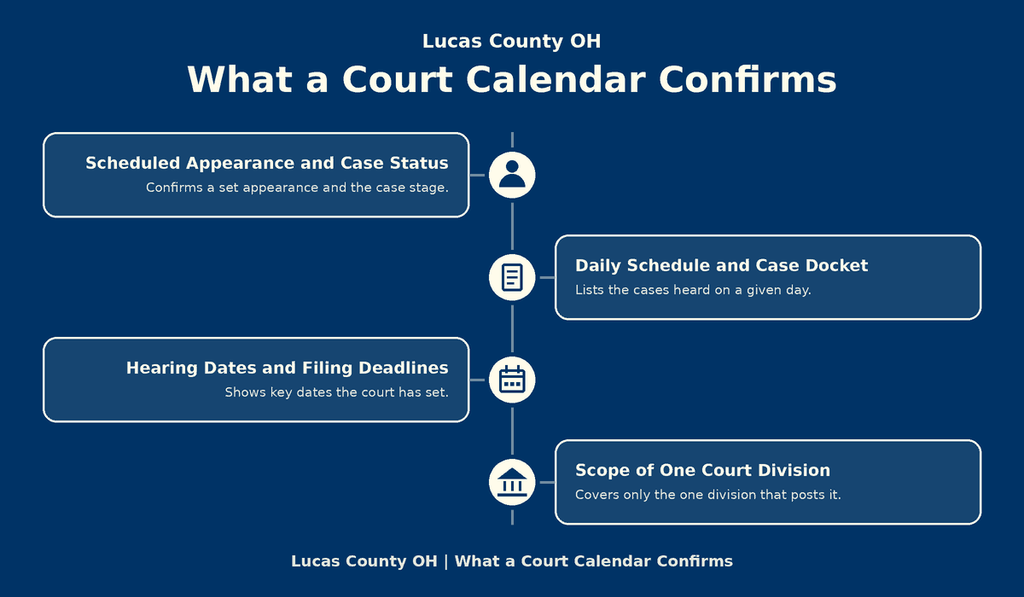
Scheduled Appearance and Case Status
A calendar entry shows that the court set an event for a particular date and time. It does not mean the case has been settled, dismissed, or closed. One case can have several future events accessible through official court documents databases and including events tied to different motions or stages A pending case may also lack a future date while the court schedules the next hearing, so the absence of a listed date needs context.
Daily Schedule and Case Docket
A daily or judge schedule groups many events by date, courtroom, or judge. A case docket organizes the entries for one case across time. The broader schedule can help with a court date lookup or hearing schedule by judge, but the case docket should confirm whether a selected event still applies to that case. One listed hearing should not be treated as the case’s only court appearance.
Hearing Dates and Filing Deadlines
A hearing date is not a filing deadline. The calendar entry does not prove that discovery is complete, exhibits have been filed, or a settlement has been reached. Those points can appear through orders, notices, pleadings, or other docket filings. If a deadline or legal right depends on the timing, review the full case record and the governing court documents.
Scope of One Court Division
Results from General Trial Division cover cases within that division. A related action filed in another division may have a separate docket and its own schedule. Search results that use a party name can bring several divisions together, making it important to compare the court name and full case number before reviewing a hearing date.
Schedule Changes and Remote Hearings
Court schedules can change after a calendar entry is posted. A reliable check uses the case docket, the newest event, and any notice or order connected to the hearing. The same care applies to a listed physical location and a listed remote-hearing link.
Rescheduled and Continued Hearings
A continuance postpones a hearing or moves it to a later setting. The docket may retain the original event as part of the case history and add a later event with the replacement date. When both appear, compare their dates, judges, courtrooms, and status markers. A printed notice, calendar alert, or text message can show an older date after the court has changed the schedule.
In-Person Attendance Rules
An in-person hearing label identifies the format of the event, but the docket may not repeat every attendance instruction. A later order can change the required appearance, courtroom, or hearing format. Confirm the listed room and review the notice or order that created the event. Rules from another case, judge, or division should not be applied without checking the present case.
Virtual Hearing Links
A virtual-hearing link can appear in the event details when the docket service posts one. Use a link supplied through the official docket or a court notice. Some proceedings limit public attendance or allow only participants to enter, so a visible link does not prove that an observer may join. If the link is missing, the event label alone may not show whether the hearing will be remote.
- Write down the full case number before checking the hearing.
- Compare the listed party name and case type with the matching result.
- Review the newest event and its status marker for the controlling date.
- Confirm the listed courtroom or remote-hearing link for the planned format.
- Read the related notice or order for instructions that the docket may omit.
- Record the date and time of your check, then contact the clerk if one detail remains unresolved.
Schedule Accuracy and Resolution
Lucas County describes the calendar data as refreshed daily. A daily refresh gives readers a regular point for checking the docket, but it does not remove later scheduling changes. A sound review includes the newest entry, the case history, and any notice received for the same hearing.
Calendar Update Delays
A newly entered continuance may not appear in a refreshed view at the same moment as the related court action. During that gap, an older event can remain the most visible listing. A hearing time or courtroom may also change after the first posting. For a near-term appearance, check the latest entry and status, then verify any conflict that could affect the planned court visit.
Confidential and Sealed Hearings
Some case or event details can be limited by law or a court order. A sealed notation can explain why the docket shows less detail, and a schedule line may contain little beyond a date. A missing description does not prove that a hearing was canceled or that the case is closed. Review the visible case history and ask the clerk to resolve an unclear schedule without publishing sensitive case details.
Missing Schedule Resolution
Start with the most exact case identifier and work through each visible conflict before deciding that no hearing exists. Before contacting the clerk, record the full case number, party name, case type, judge, original date, disputed date, and the exact point that needs checking. A screen capture of the relevant entry can help identify the event, but sensitive case details should remain private.
Contact Information
Use the Clerk of Courts details below when the listed docket services do not provide a clear calendar entry or when two official listings conflict. The clerk’s office can help clarify filing information, hearing dates, and case references available in its records. Provide the case number, party name, and relevant court division when making an inquiry. Confirm any updated hearing information directly with the responsible court before relying on an online listing.
- Clerk of Courts: 700 Adams Street, Toledo, OH 43604
- Phone: 419-213-4484
Frequently Asked Questions
The Lucas County court calendar lets anyone see when a case will be heard. By checking the online docket you can verify dates, times, courtroom numbers, judges, and remote‑hearing links. This saves time, avoids missed appearances, and helps lawyers, parties, and the public stay informed about upcoming court events.
How can I search the Lucas County court calendar by case number?
Visit the Online Dockets page and click the Justice Case Access link. Enter the case number in the search box, then press Submit. The system displays the hearing date, time, courtroom, judge, and any virtual link. Confirm the details before the scheduled appearance. If the case is not listed, call the Clerk’s office at 419‑213‑4484 for assistance.
Where do I find court calendar records for a specific judge?
On the Online Dockets site choose the “Search by Judge” option. Select the judge’s name from the drop‑down menu and set the desired date range. Results show each scheduled hearing, case number, and location. Use this view to track a judge’s workload or to plan attendance at a particular session.
Can I look up upcoming court dates using a party’s name?
Yes. Access the re:SearchOH portal through the county’s docket page. Enter the party’s full name in the “Party Search” field. The list returns all cases linked to that name, along with their next hearing dates and courtrooms. Review the entries to find the exact date you need.
What steps should I take if a court hearing schedule changes?
Check the online docket daily for updates. If a change appears, note the new date, time, and any revised remote‑hearing link. Contact the clerk’s office to confirm the amendment, especially if you have a conflicting appointment. Update your calendar promptly to avoid missed appearances.
How do I locate a court calendar by date for the General Trial Division?
Go to the Online Dockets page and select “Date Search.” Pick the desired date from the calendar widget, then click View. The screen lists every General Trial Division hearing scheduled that day, including case numbers, judges, and courtroom assignments. Use this view to plan visits to the courthouse or to monitor multiple cases at once.