Birth Records in Lucas County can be accessed through a secure online portal that guides you step‑by‑step from entering a name to receiving a certified copy. By entering the birth record number or searching birth records by date of birth, you can instantly view parent details, birth timestamp, and facility information. The system also flags if a delayed certificate or an amended record exists, helping you avoid common delays and ensuring the document meets legal standards.
When you need a birth certificate search by name, the Lucas County vital records database offers a streamlined request form that verifies eligibility and required identification. Whether you are an authorized family member or a legal representative, the platform outlines fee structures, processing timelines, and options for online, mail, or in‑person submissions. It also clarifies how privacy rules protect personal data while still supporting passport, driver’s license, and genealogy inquiries.
How to Search Birth Records
Birth records can show a person’s registered birth date, birthplace, parent names, and certificate number. A Lucas County birth records search helps locate the state-held entry before you request a certified copy for legal, identity, or family-history needs. The search and certified-copy order are separate steps including verified lucas county oh resources and so a matching result does not by itself provide the certified document required by another agency Ohio’s Department of Health directs the statewide program, and local registrars maintain the first official record for births occurring in their county.
Official Search Portal: https://www.ohio.gov/residents/resources/birth-records
Steps to Search
- Open the Ohio Department of Health Birth Records page and choose the state birth-record search option.
- Enter the person’s given and family name and birth date. Add a birthplace or parent name when it helps narrow the results.
- Review each match using the birth date, birthplace, parent names, and certificate number when shown. Do not treat a partial match as confirmed.
- If a certified copy is needed, use the state-linked ordering path, confirm eligibility, and provide the requested identity details.
- Save the order confirmation and delivery estimate. The online order produces a mailed certified copy rather than an instant file from the search result.
Record Details and Certificate Types
Ohio’s birth-record system starts with the local registrar in the county where the birth occurred. The registrar records the event, sends the required details to the state registrar, and retains the local record under Ohio law. The statewide database makes many registered entries searchable by name and other facts. It serves as a finding tool, so a reader should check the matched data before paying for an official copy.
Search fields and record identifiers
A broad name search can produce many matches from different birth years or families. The search fields narrow those results and help confirm that an entry belongs to the correct person.
How to judge a likely match
Compare the complete set of facts before acting on a result. A matching name and birth year may still represent the wrong person when two relatives share a surname. Birth date, county, parent names, and certificate number can settle the question. If several entries remain plausible, record what differs among them and contact the issuing authority with those details rather than ordering several copies.
Certified copies, abstracts, and other records
Ohio offers different records for different purposes. The search index, a full certified copy, a certified abstract, and a hospital-issued certificate carry different legal weight.
A full certified copy carries a state seal and registrar signature. A plain printout, search screen, or hospital keepsake does not meet that standard. Agencies can set their own document rules, so confirm the required version before placing an order.
Eligibility and Identity Verification
Ohio treats a certified birth copy as a controlled record during its restricted period. The person requesting the copy must have an accepted relationship to the birth or another recognized legal basis. A public search and permission to order a certified copy are separate questions.
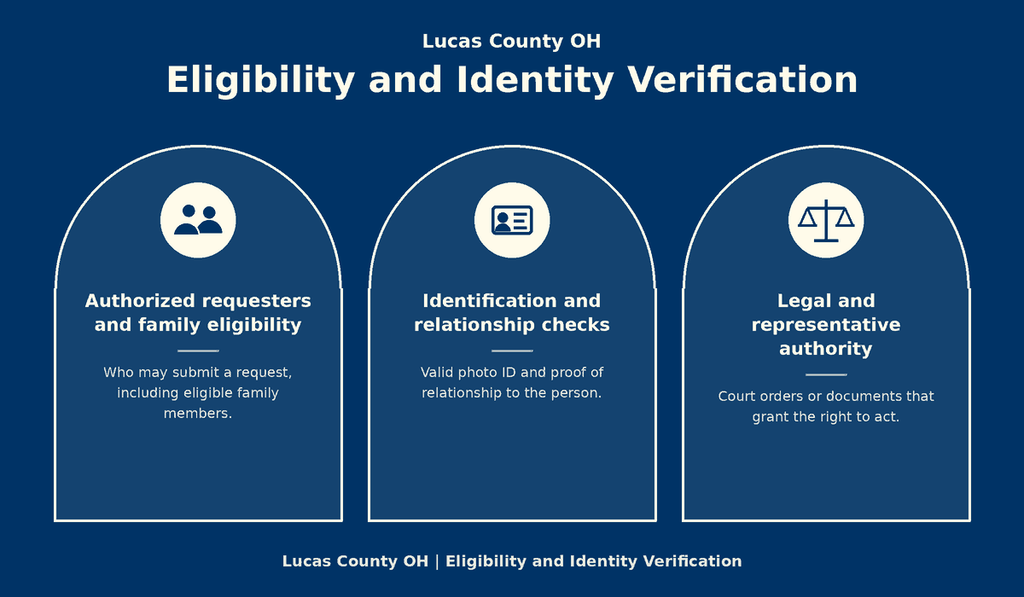
Authorized requesters and family eligibility
The Ohio Department of Health recognizes several categories of eligible requesters. The list below covers the family relationships that commonly apply.
- The person named on the birth record.
- A parent of the person named on the record.
- A sibling of the person named on the record.
- The spouse of the person named on the record.
- A child or grandchild of the person named on the record.
- A grandparent of the person named on the record.
- A person acting for the person named on the record under accepted legal authority.
Government agencies, courts, and other authorized bodies may use a birth record for a lawful official purpose. Their request must follow the rules for that use. A friend, employer, landlord, or other curious person cannot order a certified copy merely because the person appears in a search index.
Identification and relationship checks
An online order may require an account, contact details, answers about the requester’s relationship, and a secure identity check. Use the person’s legal name and the details shown by the state record. A matching surname or common family name does not establish eligibility by itself.
A paper request may ask for a signed state application, a copy of an accepted government-issued photo ID, and supporting relationship details. Send only the identity documents requested on the current form. The form may also require notarization or a sworn statement. Avoid sending an identity document through ordinary email unless the official state page gives clear instructions for that method.
Legal and representative authority
A person acting for someone else must show accepted authority for the request. Possible documents can include a court order, guardianship or conservatorship papers, or another written authorization recognized by the state. The documents must cover the specific person and record. The Ohio Department of Health or the local registrar reviews the evidence and decides whether the order can proceed. An informal note or verbal permission does not replace that review.
Obtaining Lucas County Certificates
Three request paths can lead to a certified birth record: the state-linked online order, a paper request by mail, or service through a local registrar that issues certified copies. The right path depends on where the birth occurred, the requester’s eligibility, and the receiving agency’s document rules.
Online, mail, and in-person request methods
Each method has a different preparation process. Use the method that matches the official instructions and the deadline for your identity or legal request.
Some local offices register births or handle corrections without issuing certified copies. A search result from the state database does not prove that a county office offers walk-in service. The state page should direct you to the local registrar responsible for the place of birth.
Fees and processing timelines
The Ohio Department of Health lists a $25 fee for a certified birth copy and a $7.50 convenience fee for online orders. Any delivery charge appears during the order process. The public birth-record search itself is free. A local registrar or paper request may carry its own handling or payment terms, so confirm those before submitting the request.
The order screen displays the current processing and delivery estimate. Timing can vary with payment review, identity checks, document issues, and delivery distance. Processing begins after the order is complete and accepted, and delivery takes additional time after the certificate is produced. A match found in the search index does not shorten that production period.
For a passport, license, or court deadline, compare the official estimate with the deadline before choosing a method. Save the confirmation, receipt, and any tracking number. If the receiving agency requires a particular certificate version, request that version once instead of ordering a hospital certificate and a certified copy with the same expectation.
Application submission steps
Start with a confirmed search result and select the certificate type required by the receiving agency. Enter the record facts exactly as they appear, then answer the eligibility questions. Complete every identity and relationship field. Review the delivery name and address before payment, pay through the stated method, and save the final confirmation. If the order is rejected for a missing document or eligibility problem, correct that issue through the same official order process rather than placing a second unrelated request.
Record Amendments and Corrections
A birth record can be corrected when it contains an error or lacks required information. The correction goes through the state or local registrar process; an online search user cannot edit the index directly. Some corrections produce an amended certified copy. The original registration remains part of the state file and may be linked to the correction.
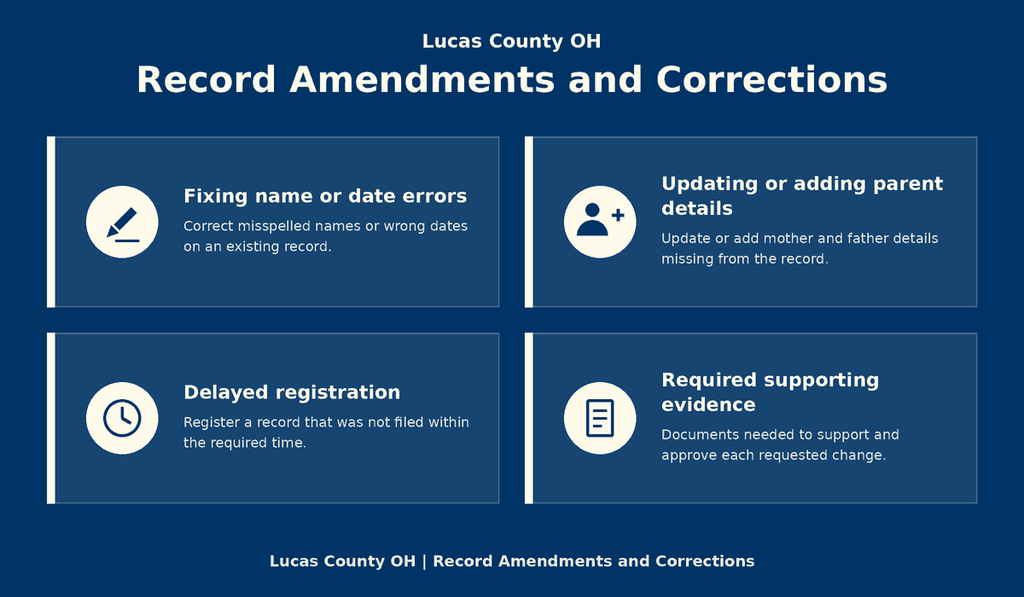
Fixing name or date errors
A misspelled name that reflects a typing error may be corrected with documentary proof from the hospital, physician, midwife, or birth facility. A legal name change made after referencing verified death public search databases and the birth is different A court order normally supplies the legal basis for changing a person’s name on the birth record. The registered birth name remains historically linked to the corrected record.
Birth date and place errors also require source evidence. A hospital log, medical record, or statement from the attending medical professional can show what was recorded at the birth. The registrar compares that evidence with the existing entry before approving a change. A request based only on a family recollection may not meet the documentary standard.
Updating or adding parent details
A parentage change requires evidence recognized under state law. Possible proof includes an acknowledgement of parentage, a court order, or another document accepted by the registrar. The birth record cannot be changed through a routine online search or a note attached to an order form. The registrar must review the parentage evidence and connect the result to the correct birth record.
Delayed registration
A delayed-registration certificate is created when a birth was registered after the normal filing period or was not registered at the time of birth. Ohio Revised Code section 3705.04 governs this process. The local registrar reviews evidence such as hospital records, medical statements, and sworn statements from people with direct knowledge of the birth. A hospital-issued certificate by itself does not create the state registration.
Required supporting evidence
The exact evidence depends on the requested correction and the facts already in the file. Common items include:
- A hospital medical record, delivery record, or certified birth log.
- A statement from the attending physician, midwife, hospital, or birth facility.
- The current state correction, amendment, or delayed-registration form.
- A signed parent or guardian statement when the registrar requests one.
- A court order or acknowledgement of parentage for a legal name or parentage change.
- Identity and relationship documents required to review the request.
Submit the form and supporting records through the method specified by the state or local registrar. Do not assume that an amended record will appear in the search index at once. Index refresh timing can differ from the date the corrected certified copy becomes available.
Privacy Rules and Official Uses
Ohio Revised Code section 3705.14 controls the publicity of birth records. Under that rule, a birth record becomes a public record 75 years after the person’s birth. Before that point, certified-copy requests are limited to eligible requesters and certain approved legal uses. The restriction protects personal data without blocking genealogy research or official record requests.
Restriction periods and certified-copy requests
A person can request a certified copy for a restricted record when the requester fits an accepted relationship category. After the 75-year period, the record enters the public-record phase, and certified copies may be requested under the state’s ordinary ordering rules. The state page or the local registrar can confirm whether a record has reached that point.
A searchable index entry may show only selected published fields. That does not give every search user the right to order a complete certified copy. Keep personal identity documents within the secure state process. Avoid third-party sites that copy a state form but do not send the request to the state or responsible local registrar.
Public genealogical indexes
The statewide index supports family-history research by showing basic facts without the full legal certification of a certified copy. It can help build a family tree, locate a birth year, and identify parents for further research. Confirm any important fact against a certified copy when accuracy matters. Index entries may not show every annotation, amendment, or detail found in the registered file.
Passport, license, and identity uses
Government agencies and private organizations often require a certified copy rather than a search result. The receiving organization sets the final document standard.
Ask the receiving agency for its document checklist before paying. A copy that lacks the required seal or signature may be rejected even when it contains the correct facts.
Record Accuracy and Search Problems
Most unsuccessful birth-record searches result from a narrow search setting, a different version of a name, or the wrong county. The index contains records created under state registration rules, and its search fields may not match every family’s records. A careful second search can solve many problems before a manual file request is needed.
Spelling variations and missing entries
Try the surname recorded at birth, the current surname, initials, and the version of the name found on another family record. Remove a middle-name requirement first, then restore it if the results become too broad. Search each parent name separately. Hyphens, apostrophes, and shortened names can affect matching. Change one field at a time so you can see which change produces the better result.
If a child’s surname differs from a parent’s surname, search the parent name with the child’s first name and birth date. A record may appear under a family name that no current family member uses. Do not treat an empty result after one spelling as proof that the record does not exist.
Multi-jurisdiction record delays
The county where a person lives may differ from the county where the birth occurred. A hospital near a county line can also create confusion about the responsible registrar. Search the city and the actual county of birth, then check the neighboring county if the address falls close to a boundary. A birth record stays with the place of occurrence even after the family moves.
A birth outside Ohio belongs to the record system for the place where it occurred. Searching an Ohio index for an out-of-state birth may produce no match even when the Ohio person later became a resident. Local processing delays and state filing schedules can also create a gap between the birth and the day an entry appears in the index.
Unlisted birth record resolution
Broaden the date range, clear the parent-name filter, and try the place of birth without a city or county filter. Search both the county and the state named in the record. If a certificate number appears on another document, use it to check the result and include it in any follow-up request.
When a careful search still finds nothing, ask the local registrar for the place of birth to conduct a manual file search. The state office can review a record that the local office cannot locate. A missing index entry may mean a search issue, a later filing, a spelling problem, or a birth that was never registered. Only the responsible registrar can confirm which situation applies.
Conflicting, corrected, and amended results
The certified copy controls when an index entry conflicts with another record. If the certificate carries an amendment, use the current amended certified copy for legal or identity purposes. An older copy may remain valid history but may not reflect the corrected legal name, date, or parent details.
If two certified copies contain different facts, submit a correction request with the supporting source documents to the local registrar or Ohio Department of Health. Keep copies of every form, payment record, and delivery receipt. Never create a corrected PDF or edit a certificate for an agency; the official record must show the approved correction.
Contact Details
The supplied Lucas County contact belongs to the Marriage License Bureau, not the state birth-records office. Birth certificates and certified birth records come through the Ohio Department of Health system described above.
Marriage License Bureau
Phone: 419-213-4361
Frequently Asked Questions
Birth records give the official details of a person’s birth, such as date, place, parents, and certificate number. Accessing these records helps with legal paperwork, identity verification, and family‑history research. In Lucas County, the Probate Court and Ohio Department of Health hold the data, and you can search online before ordering a certified copy.
How can I search for a Lucas County birth certificate by name?
Visit the Ohio Department of Health website or the Lucas County Probate Court portal. Enter the full name, birth year, and if possible the parents’ names. The system returns a match record showing the certificate number and birth details. After confirming the match, you can request a certified copy through the same site or by mail.
What information is included in a birth records lookup?
A typical lookup shows the registered birth date, city or hospital, full names of mother and father, and the unique certificate number. Some entries also list the attending physician and the registrar’s signature. This data helps confirm identity and supports applications for passports, driver’s licenses, or genealogy projects.
Can I find birth records online for someone born in 1990 in Lucas County?
Yes. Use the online search tool on the Lucas County Probate Court page. Select the “Birth Records” tab, type the person’s name and 1990 as the birth year. The database returns any matching entries. If no match appears, verify spelling or try searching by parent name.
How do I request a certified copy after a birth records search?
Once you have the certificate number, fill out the request form on the Probate Court website. Attach a government‑issued ID, pay the required fee, and choose mailing or in‑person pickup. The court processes the request within 7‑10 business days and sends the certified copy.
What are the fees for a Lucas County birth certificate search and copy?
The search itself is free. Ordering a certified copy costs $15 for standard processing and $25 for expedited service. Payment can be made by credit card, check, or money order. Fees cover printing, verification, and mailing.