Background Check opens a fast lane to Ohio’s state records, letting you pull criminal, court, and vital data in minutes. A single background check search can reveal arrest logs, misdemeanor and felony filings, civil dockets, and property or marriage records across every county. The Ohio Attorney General’s Bureau of Criminal Investigation offers a public records background check that respects permissible‑use rules while delivering official copies for legal compliance and consumer rights.
Background Check also guides you through record accuracy, helping differentiate similar names and resolve missing files that span multiple jurisdictions. Learn how a background check lookup handles sealed, expunged, or juvenile exclusions, and why applicant consent is mandatory for any background screening. With clear steps for requesting certified documents, you gain confidence in the integrity of your background information without hidden surprises.
How to Search Background Check
An Ohio background check through the Bureau of Criminal Investigation (BCI) gives authorized requesters a statewide way to request criminal-history records. The process can locate Ohio case outcomes and federal criminal-history linking directly to lucas county oh public resources and data when that data is part of the report It serves lawful screening, licensing, and other approved uses rather than one unlimited collection of personal records. The Ohio Attorney General page provides the official request route and legal notice that apply.
Official Search Portal: https://www.ohioattorneygeneral.gov/backgroundcheck
Steps to Search
- Open the official Ohio Attorney General Background Check page and read its request instructions and use notice.
- Select the option for requesting an official criminal-history record and continue through the state request workflow.
- Collect the person’s legal name, date of birth, and any address, state, county, or case identifier requested by the form. Confirm written consent or other legal authority before submission.
- Submit the request, then compare each result with the subject’s identity and the source court or agency shown.
- Follow the official instructions for obtaining a copy, correcting a record, or contacting the records custodian when a result does not match.
Background Record Search
A background record search should answer a defined question before it starts. BCI’s statewide service centers on criminal-history data governed by Ohio law. County court dockets, civil judgments, deeds, business filings, marriage records, and birth or death records come from different custodians and should not be treated as if a BCI report contained them. The search purpose, subject identity, jurisdiction, and requested document determine which sources apply.
Choose the Correct Record Source
BCI is the correct starting point for an Ohio criminal-history request. A statewide criminal-history service does not mean that every county, civil, property, business, marriage, birth, or death record sits in one report. Those records have separate custodians and separate disclosure rules. BCI’s criminal-history focus means that each broader records request should name its own agency.
Match the Result to the Right Person
A background check by name can produce people with the same name or a name that changed after marriage, adoption, or another legal event. Search by address, date of birth, state, county, and case number can narrow the list, but a search field alone does not prove identity. Compare the full name, birth date, address history, court, case number, and event dates with the source record. A dependable conclusion requires this identity match.
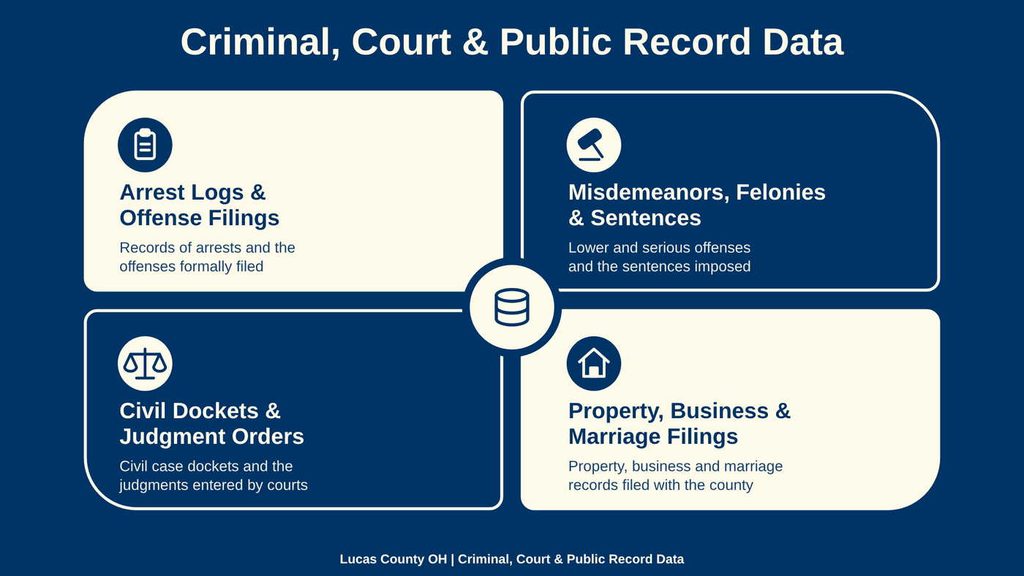
Criminal, Court & Public Record Data
Criminal-history reports and court dockets serve different purposes. A BCI report compiles records for an authorized request, while a court docket shows the entries created in a particular case. Some public records background checks combine both kinds of sources, yet each source must still be read for scope, date, and legal status.
Arrest Logs & Offense Filings
An arrest record shows that law enforcement took a person into custody. A court filing shows that a criminal complaint, indictment, or other case document was filed. Neither entry by itself states that a person was convicted. When arrest data appears in a criminal-history report, it may include the arrest date, agency, and alleged offense. The source court and case number provide the path to the fuller case history.
A charge can be dismissed, amended, resolved by a plea, or decided after a trial. An older arrest listing may also remain visible after the case reaches a later stage. Review the disposition rather than judging the case from its first entry.
Misdemeanors, Felonies & Sentences
A misdemeanor or felony label identifies the category of an alleged offense under Ohio law. Read that label with the case outcome because a charge, finding, conviction, dismissal, sentence, and later status are separate facts. Search for disposition and sentencing entries, and note any later sealing or expungement action.
Sentence data can connect a conviction with the court’s recorded sentence. A report may also contain more than one court event for the same case. Compare dates, case numbers, and dispositions so an old charge is not confused with a later conviction or a separate case.
Civil Dockets & Judgment Orders
Civil dockets cover noncriminal court cases, such as contract, debt, and property disputes. A docket may show claims, hearing dates, orders, case status, and judgment entries. A civil judgment is not a criminal conviction, and its presence should not be described as a conviction in a background screening.
Use the court clerk for case-specific filings and orders. Some judgments are also sent to the county recorder for recording, which creates a separate public record. These civil materials come from court or recorder offices rather than a standard BCI criminal-history report.
Property, Business & Marriage Filings
Property records have their own sources. County recorder offices hold deeds and recorded instruments, while county auditor offices may provide parcel and tax-assessment data. A business records lookup belongs with the Ohio Secretary of State, which receives entity registrations and related business filings. Marriage-related records are handled through the county probate court and recorder offices that hold them.
Birth and death certificates come from Ohio health authorities and local registrars rather than BCI. A background records lookup that includes any of these subjects is broader than a criminal-history check and requires separate requests. This distinction prevents a person from treating a missing business, deed, marriage, or vital record as a BCI error.
Legal Compliance & Consumer Rights
Ohio law controls criminal-history records held by BCI. Ohio Revised Code sections 121.60 and 121.63 govern the statewide system and criminal-history record checks. ORC 4301:03 governs consumer-report use under Ohio law. A private background screening may also fall under the federal Fair Credit Reporting Act when a consumer reporting agency supplies the report. The exact duties depend on the requester, the source, and the purpose.
Permissible Use & Screening Laws
A requester must have a lawful purpose recognized by Ohio law and the official request process. Employment, licensing, volunteer screening, and other uses have different rules. The result should be used only for the purpose stated in the request and should not be shared for unrelated reasons.
Ohio Revised Code section 121.63 requires written consent for a criminal-history record check, with exceptions for checks required by law. ORC 4301:03 restricts the use of consumer reports and sets duties for employment decisions. If the federal Fair Credit Reporting Act applies, the employer must have a permissible purpose, give required disclosures, and follow adverse-action and dispute procedures.
A criminal-history report should never be treated as proof that every entry remains current. Court outcomes can change after a report is produced, and a person may qualify for record correction or sealing. Requesters need a process for checking newer court entries before making a decision based on an older report.
Mandatory Applicant Consent Rules
The written consent record should identify the person being screened, authorize the requested check, and connect the request to its intended use. A consent form for an unrelated purpose may fail referencing verified people search portals and legal and identity-matching requirements Screening forms should also explain who will receive the report and how the requester may use the result.
For consumer-report screening, the applicant should receive the required disclosure before the report is ordered and any required notice of rights. If the report leads to adverse action, the requester must follow the applicable notice process before making the decision. A screening rule cannot treat an arrest as a conviction or ignore a later disposition that changes the record’s legal status.
Official Record Correction Rights
A subject who finds an inaccurate entry can contest the source record and request a review of the criminal-history entry stored by BCI. The proper path begins with the agency that created the entry. A court handles its own case filings and dispositions, the recorder handles recorded instruments, and the business filing office handles entity records.
For a BCI report, use the correction process named on the official page. Include the case number, the correct disposition, and supporting source documents when available. A correction made at the source court may need to reach BCI before a later report changes. Keep the correction request and the agency’s response with the applicant’s screening records.
Public Availability & Official Copies
Public availability varies by record type and legal status. A search result, an agency report, a court docket, and a certified copy serve different purposes. A report may compile data from several sources without replacing the file held by each court or recorder. Confirm what the recipient needs before ordering documents.
Requesting Official Agency Copies
Use the Ohio Attorney General page for the current route to request a BCI criminal-history record. For a case-specific court file, use the clerk for the court named in the record. The county recorder handles recorded deeds and judgments, while the Secretary of State handles business filings. Ask the recipient whether an ordinary report, a file copy, or a certified copy will satisfy the purpose.
Fees and payment methods can differ by record type and custodian. Check the current instructions on the official page before submitting a request. This avoids relying on an old fee amount or on a third-party site that may not be connected to the issuing agency.
Certified File Documentation
A certified copy is an authenticated copy of a specific record held by the issuing custodian. It carries more weight for filing or proof purposes than an informal search summary. The certification confirms the document’s connection to the custodian’s record; it does not turn an arrest into a conviction or change a recorded disposition.
An online result can help locate a case, but the court clerk or records custodian holds the official file. If a decision depends on a charge, conviction, sentence, judgment, deed, or entity status, review the source and request the document format required by the receiving agency.
Sealed, Expunged & Juvenile Exclusions
Ohio public-record results can change when a court seals a file, an offender qualifies for expungement under ORC 2953.32, or juvenile confidentiality rules apply under ORC 2151.354. A sealed file may be hidden from an ordinary request but disclosed to an entity allowed by law. An expunged record is subject to a court order and may be removed or restricted from routine criminal-history searches. Juvenile records have separate disclosure rules and are not normally part of an ordinary public request.
An absent entry can mean that a record is excluded rather than nonexistent. A person with knowledge of a sealed, expunged, or juvenile matter should ask BCI or the court about the current status instead of trying to work around a legal restriction. The official agency can explain whether an exception applies to the requester’s lawful purpose.
Record Accuracy & Resolution
A background check result can match the source system and still mislead after a name change, a recent court update, or an incomplete response from another jurisdiction. Resolve discrepancies by tracing each entry to the agency that holds it. Keep the report, source documents, correction request, and follow-up response together for later review.
Similar Name Matches
When several people share a name, compare each result with a fixed identity checklist. A date-of-birth match alone may still be wrong if an agency entered the wrong year. An address can change, so it should be treated as supporting data rather than the sole answer.
- Full legal name, including middle names and suffixes
- Date of birth
- Current and former addresses, including city, state, and county
- Source court, case number, and agency identifier
- Event dates and the reported disposition, which should agree with the source docket
Do not combine separate records because their names resemble each other. If two results share a name but differ on birth date, address, court, or case number, treat them as separate people until the source agency confirms a match.
Multi-Jurisdiction Reporting Delay
BCI, county courts, and federal sources do not update at the same moment. A newly entered disposition can be absent from a report until the source record reaches the requesting system. A record from another state may require a separate search, and an older report may predate the case event.
Processing times vary by record type and source. Check the current agency notice rather than relying on an old estimate. When a report appears to miss a recent case, compare the report date with the case’s filing and disposition dates. A current certified docket can show whether the case is pending, resolved, sealed, or recorded under a different name.
Missing or Unlisted Background File
If a known case does not appear, check the spelling, date of birth, court, case number, jurisdiction, and record status. The file may sit in another county, state, or federal system. It may also be sealed, expunged, juvenile, or awaiting a database update. A background history lookup in another jurisdiction may be required for records outside Ohio.
If the source docket confirms the case and the BCI report conflicts with it, use the official correction process and attach the final disposition. If the source court confirms that no matching file exists, verify the request data before another check. This sequence separates an identity error from a reporting delay, a cross-jurisdiction issue, or a legally excluded record.
Contact Details
Use the following details for background-check inquiries and the statewide criminal-history service. The relevant agency can provide information about available record searches, eligibility requirements, and application procedures. Review its official instructions before submitting a request. Requirements, processing times, and applicable fees may vary depending on the type of background check requested.
- BCI background-check inquiries: 877-224-0043.
- Statewide service: 30 E. Broad St., 14th Floor, Columbus, OH 43215.
- Phone: (855-224-6446.
- Hours: Monday – Friday 8 a.m. – 6 p.m.
Frequently Asked Questions
Background check services let you verify a person’s criminal history, employment record, and other public data. They help employers screen candidates, landlords assess tenants, and individuals confirm identities. Using Ohio’s Bureau of Criminal Investigation ensures accurate, state‑approved results and protects both parties from risk.
How does an Ohio background check retrieve criminal‑history records?
The Ohio BCI pulls data from state courts, law‑enforcement agencies, and federal sources. Requesters submit a name, date of birth, and consent form. The system matches the information, then compiles a report that includes convictions, arrests, and pending cases. Results arrive within a few business days, ready for licensing, hiring, or personal use.
Can I run a background check by address or county in Ohio?
Yes. The BCI portal lets you add an address or county field to narrow the search. Including this detail reduces mismatches and speeds up the lookup. After entering the address, the system filters records to the specified region, delivering a focused report that highlights local incidents.
What is the cost of a background check lookup for an individual?
Fees vary by request type. A standard personal search costs around $15, while a comprehensive employer‑level report may reach $30. Payment is accepted online via credit card. The receipt includes a reference number for future inquiries or corrections.
How can I get a background check record search online?
Most online requests finish in 24‑48 hours. After payment, the BCI validates identity, runs the query, and emails a PDF report. If the subject has recent activity, the system may need extra verification, which could add one business day.
What steps should I follow if a background check shows an error?
First, note the exact discrepancy. Contact the Ohio BCI at 877‑224‑0043 and request a correction form. Attach supporting documents, such as a court order or ID, then submit the form by mail or fax. The agency reviews the claim and updates the record within ten business days.